History of the Event
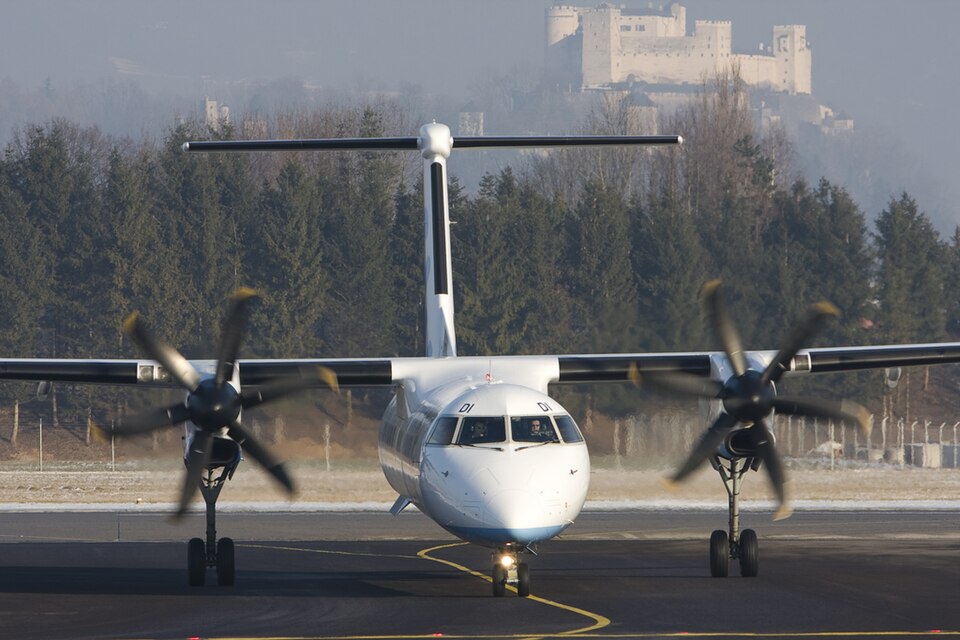
On 5 January 2005, at approximately 0715 UTC, the flight crew of a DHC-8-402 (registration G-JEDI) was taxiing along Taxiway A towards Runway 15 at Birmingham International Airport. After passing a metal plate in the taxiway, the commander turned the nosewheel steering tiller to the right to centralise the aircraft, but this input had no effect. A larger tiller input also failed to produce a turn. The commander then applied right rudder and right brake pedal pressure, bringing the aircraft to a halt with its left main landing gear on the grass adjacent to the taxiway. At that moment, the crew noted that the 'nose steering' fault light was illuminated and the co-pilot's airspeed indicator (ASI) had failed. The reported wind was from 210° at 11 kt, creating a significant crosswind from the left.
The crew recycled the 'nose steering' control, and the warning light extinguished. However, they were unable to taxi forward with the left main landing gear on the grass. Passengers were disembarked onto a bus, and the aircraft was pushed to a stand for engineering investigation.
Engineering Investigation
Analysis of the flight data recorder (FDR) revealed that the 'weight-on-wheels' (WOW) signal was lost for one second early during taxi and again at the point where the crew reported losing nosewheel steering control. The DHC-8-402 has two separate WOW switches (WOW1 and WOW2) on the nose landing gear. Loss of signal from either sensor causes the FDR to record a loss of WOW signal and the Steering Control Unit (SCU) to remove steering commands from the hydraulic actuators. The loss of nosewheel steering from tiller and rudder inputs was entirely consistent with the loss of one WOW signal while taxiing at low speed.
The following day (6 January 2005), another ASI problem occurred on the ground with the same aircraft at a stand at Glasgow Airport. Investigation revealed a problem with the wiring harness from the WOW2 sensor, which was repaired.
The FDR data was not immediately available to maintenance engineers after the incident. The aircraft was dispatched following replacement of the SCU, based on a particular fault code stored by the SCU. The engineers did not appreciate that this fault code could indicate loss of WOW1 or WOW2. This information was provided by the aircraft manufacturer but was not included in the aircraft's maintenance manual. The airline maintenance organisation requested that the manufacturer incorporate such information into the manual.
Safety Action
On 31 March 2005, the aircraft manufacturer informed the AAIB in writing that, in accordance with the operator's request, the company would amend its maintenance manuals to include the requested information.