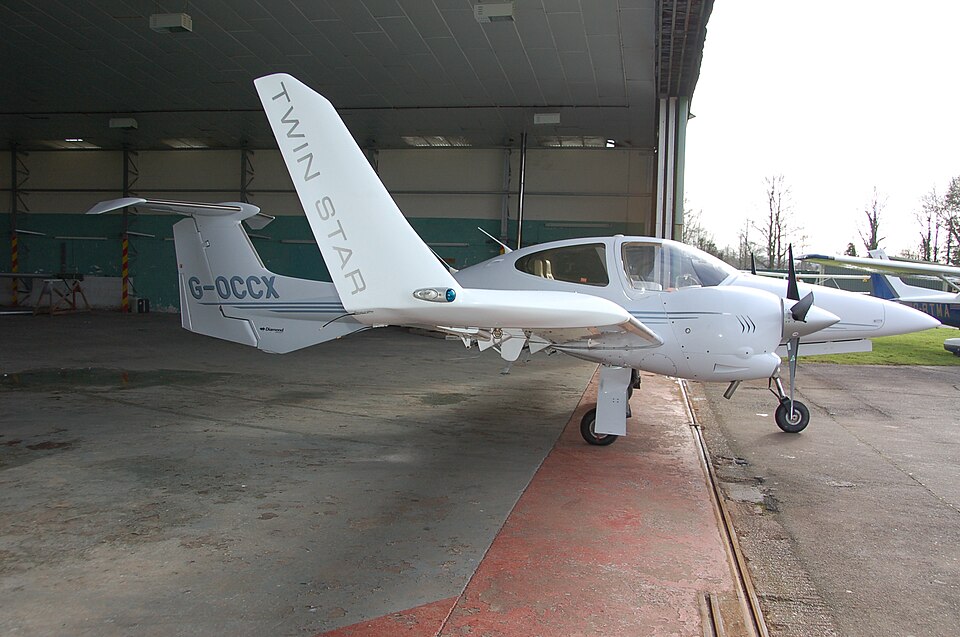
History of the Flight
On 26 March 2009 at 0952 UTC, a Diamond DA 42 Twin Star, registration G-OCCX, was conducting a training flight at Cranfield Airport, Bedfordshire. The student pilot was performing a practice asymmetric approach with a 7 kt crosswind from the right. The instructor assessed the landing as normal, though the crabbed approach was not straightened. The aircraft touched down on the left main wheel while drifting left, before the instructor could intervene. Immediately after touchdown, the left main landing gear collapsed, and the aircraft veered left off Runway 21, coming to rest on grass approximately 8 m from the runway edge. The instructor shut down both engines and the electrical systems after alerting air traffic control. Both occupants, who were uninjured, vacated the aircraft through the cockpit canopy.
Examination of Failure
The failed landing gear was examined. The accident aircraft features a primary structure largely of carbon fibre reinforced plastic (CFRP). The left main landing gear side brace attachment to the wing consists of a steel pivot pin oriented fore and aft, with its forward end bonded and encapsulated into a sandwich glass reinforced plastic (GRP) assembly. This assembly has flanges on its vertical and lower horizontal edges, bonded to the aft face of the main spar, and an upper flange bonded to the lower surface of the wing upper skin. The failure involved complete separation of the GRP assembly at the bond line. Examination of the failed bond area between the upper flange and the wing skin revealed a large void—a localized absence of bonding paste—occupying approximately one third of the surface area of the joint.
Inspection Procedure
Before this accident, voids in the bond between the sandwich assembly and wing skin had been identified as a defect in some DA 42 aircraft. A Mandatory Service Bulletin (MSB) 42-031 was issued, detailing an inspection procedure to identify this defect. The MSB requires extensive dismantling for access, then drilling three 4 mm holes through each upper flange of the sandwich assembly. During drilling, the operator assesses changes in drill torque: initially high through GRP, then decreasing through bonding paste, then either increasing significantly upon hitting CFRP or decreasing significantly if a void is present before hitting the upper shell. The drill is stopped when the upper shell is encountered, or before if resistance drops. The hole is inspected: if the bottom is light grey (bonding paste colour), a correct bond is assumed; if only black glossy surfaces are visible, no bond material is present and repair is required. The repair involves bonding new sections with joggles over the outside of the GRP assembly, with flanges bonded to the wing skin and spar. Inspection holes are then filled with resin.
MSB 42-031 had been carried out on G-OCCX before the accident. Examination of the separated assembly showed that two of the three inspection holes had been drilled into a bonded area, but the third had entered a void. The required repair/reinforcement had not been implemented.
Previous Incidents
The manufacturer stated they had good success with the MSB and were aware of only one other case of landing gear failure following the repair scheme. In that instance, the repair “ribs” had been poorly bonded during the reinforcement procedure. No other instances of a defect remaining undetected after the MSB procedure were identified. The manufacturer had considered more sophisticated examination techniques but opted for the simple drilling method, as ultrasonic inspections required experienced personnel scarce in general aviation. They also considered requiring all DA 42 aircraft to be equipped with the additional ribs, but noted that many aircraft were unaffected and doing so would impose weight, time, and cost burdens.
Conclusions
The left main landing gear collapsed during a practice asymmetric landing as a result of a failure of the bond between the sandwich assembly on the main landing gear side brace attachment and the wing skin. This was attributed to a void in the bond for which the repair/reinforcement detailed in MSB 42-031 had not been completed, although the MSB had been carried out on the aircraft.