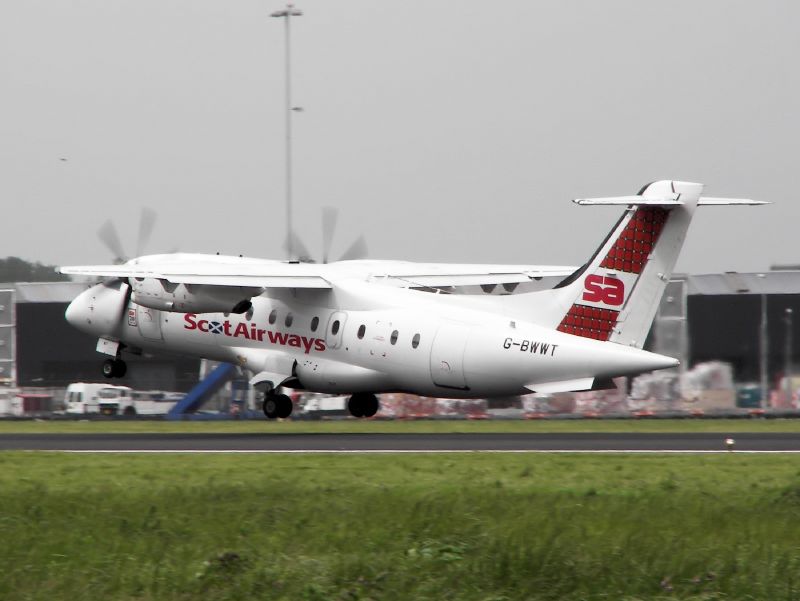
History of the Flight
On 22 March 2012, a Dornier 328-100 (registration G-BWWT) operated a scheduled passenger flight from Manchester to Norwich International Airport. The aircraft was conducting an NDB/DME approach to Runway 09. The commander, who was pilot flying, became visual with the runway at approximately 1 nm and noted the wind from 110° at 7 kt. After leveling at the minimum descent altitude of 580 ft amsl, the commander disengaged the autopilot and maneuvered to align with the runway centerline. The aircraft crossed the threshold with right bank applied and tracked toward the right edge of the runway. The right main landing gear departed the paved surface, striking and breaking a runway edge light. The co-pilot called for a go-around, which the commander executed without further incident. The aircraft subsequently conducted an uneventful ILS approach to Runway 27. After landing, the crew observed the broken light and reported the event to air traffic control.
Crew Comments
The commander later stated that forward visibility was reduced due to flying toward the sun and that his decision to continue the unstable approach was poor judgment. The co-pilot, who had gained his captaincy seven months prior, noted that this was his first flight in the right seat since promotion. He expressed slight concern during the maneuver but deferred to the commander's experience and did not intervene until calling for the go-around.
Recorded Data
Flight data recorder information showed that the autopilot was engaged with heading select throughout the approach. At approximately 460 ft above airfield level, the autopilot transitioned from vertical speed mode to altitude hold. Ten seconds later, the autopilot was disengaged, and control inputs were made to correct the aircraft's position. The aircraft then banked left 19° at about 330 ft, followed by a right bank of 30° at 110 ft. The left main gear touched down first, with the aircraft on a heading of 093°M, to the right of the runway heading. Approximately two seconds later, the right gear touched down, and the heading changed to 081°M. The aircraft lifted off four seconds after weight-on-wheels indication. An enhanced ground proximity warning system recorded a 'bank angle' alert as the right roll angle peaked at 29.5° before reducing.
Operator's Procedures and Preservation of Data
The operator's manual emphasized that a stabilized approach should be wings level by 500 ft and that non-precision approaches should be flown as continuous descent final approaches. No explicit procedure existed for preserving flight recorder data after a serious incident, and the cockpit voice recorder was overwritten before the investigation was notified. The CAA had issued a safety notice in August 2011 urging operators to establish robust procedures for preserving such recordings.
Airfield Inspection
Tyre marks from the right main landing gear were found on the runway and adjacent grass. A broken lens from a runway edge light was recovered. Engineering inspection of the aircraft revealed no damage.