History of the Flight
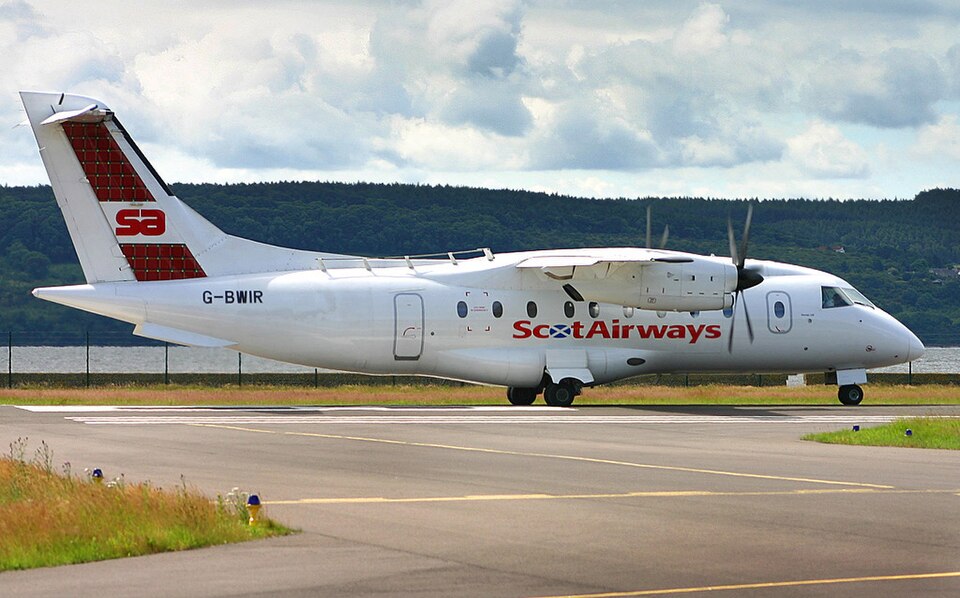
On 20 February 2005, a Dornier 328-100, registration G-BWIR, operated a public transport passenger flight from Edinburgh to London City Airport (LCY). The crew departed Edinburgh at 1423 hrs. After an uneventful cruise, they flew an ILS approach to Runway 28 at LCY, with the commander as the handling pilot. Runway 28 has an asphalt surface (dry) with an LDA of 1,319 m and a 5.5° glidepath. During the final approach stages, the tower controller transmitted two consecutive wind checks of 330°/13 kt. Shortly after touching down on the centreline, the aircraft started a veer to the right, which the commander could not correct despite applying full left rudder pedal. The aircraft departed the runway onto the grass before control was regained using asymmetric braking and asymmetric reverse thrust. As speed decayed, the aircraft was steered back onto the runway and taxied to its parking stand. The crew did not notice any EICAS status messages or warnings during the incident.
Flight Data Recorder Analysis
The aircraft was fitted with a Solid State Cockpit Voice Recorder (SSCVR) and a Solid State Flight Data Recorder (SSFDR). The CVR circuit breaker was not pulled after landing, so the recording contained only post-landing sounds. The FDR recorded numerous parameters, including air data, engine parameters, and control surface positions, but no braking system or nosewheel steering parameters. The weight-on-mainwheels discretes were activated at touchdown. Analysis showed the initial divergence began shortly after touchdown, with a calculated yaw rate of about 1°/sec. Despite full left rudder one second after touchdown, the aircraft continued right. The aircraft left the paved runway about 9 seconds after touchdown at about 48 kt. About 1 second later, the turn to the right was arrested and the aircraft started turning left. It regained the paved runway about 18 seconds after touchdown.
A difference in engine torque of about 2% (right greater than left) existed just after touchdown. At about 5 seconds after touchdown, the torque difference reversed (left greater than right) for about 9 seconds, consistent with crew attempting to control yaw with differential propeller settings. The pitch attitude remained about 1° nose-up during this part of the landing run, with elevators slightly nose-up until the turn was arrested. Comparison with the previous landing showed a pitch attitude of about 0° during that landing and other recorded landings.
Systems Description
On the ground, the Dornier 328 can be steered by differential braking, aerodynamic yaw control from the rudder, and hydraulically actuated nosewheel steering. Nosewheel steering commands come from pedal input (up to ±10°) and a hand control unit (tiller) on the left console. The tiller provides ±60° but requires engine condition levers at or below HIGH TAXI; with levers fully forward (usual after landing), no input from the tiller reaches the steering actuator. Nosewheel steering is enabled 0.5 seconds after the nose leg weight-on-wheels (WOW) switch closes; this delay resets if the switch opens, e.g., during a bounce.
Asymmetric application of Beta torque (reverse thrust) produces a yawing moment. The aircraft manufacturer’s certification tests with full asymmetry at 40 kt and 100 kt showed prompt and effective yaw control using nosewheel steering inputs up to the 10° available on the pedals.
Ground Marks and Tests
Ground marks from all three landing gears were traced back to near the runway centreline. The marks showed a progressive departure from runway heading, not corrected until the aircraft left the runway. No rubber deposits indicated heavy differential braking or anti-skid cycling, and no evidence of nosewheel steering inputs to the left (expected with full left pedal deflection shown on FDR).
Engineering investigation, including jacking tests on G-BWIR, found that with main landing gear legs bearing normal load, the nose leg WOW sensors opened at 0.6° nose-up. With main gear progressively unloaded, the nose-up pitch required to open the sensors was reduced. This supported the hypothesis that nosewheel steering was disabled during the excursion because the nose-up attitude unloaded the nose leg, preventing the WOW sensors from detecting runway contact.
The nose leg oleo strut was removed and tested; it performed within specified values for a newly-overhauled unit.
Outcome
Following the incident, the aircraft was taken out of passenger service for inspection and functional tests, including ground inspections and crew training flights. Interrogation of the Integrated Avionics Computers showed a transient ‘NWS’ message, but no link to any mechanical or system failure was found. No faults were found, and the aircraft was returned to passenger service.