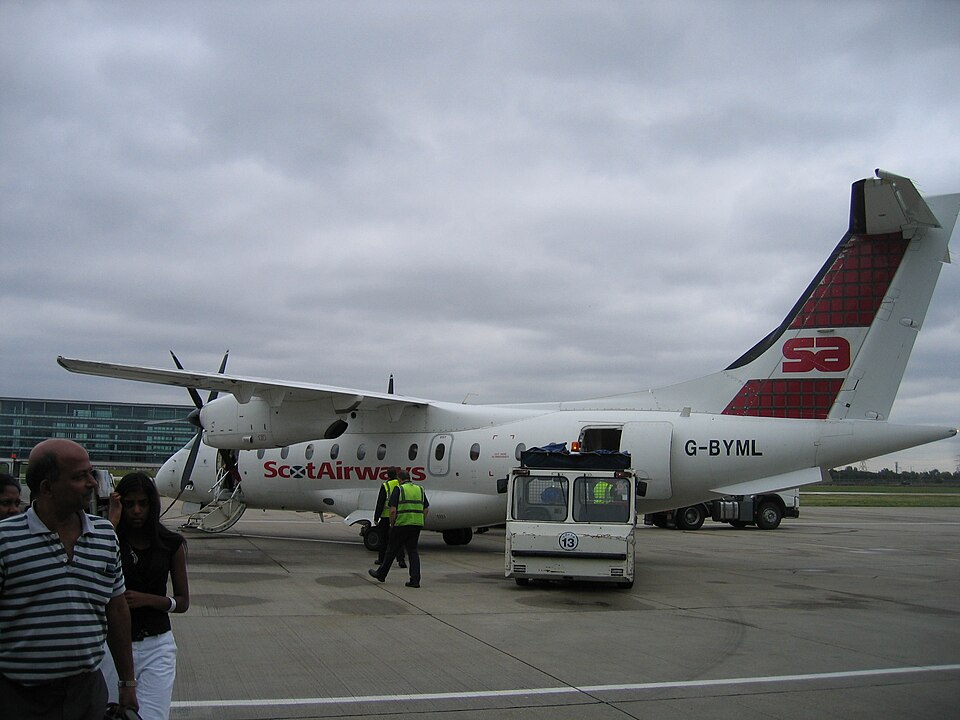
History of the Flight
The aircraft, a Dornier 328-100 (G-BYML), was taxiing for takeoff at London City Airport on 15 November 2005. The crew had already operated three sectors between Dundee and London City Airport that day. While taxiing to holding point Charlie, Air Traffic Control (ATC) informed the commander that the anti-collision lights were not illuminating. The flight crew confirmed the switch was ON and recycled it, but the lights remained off. The aircraft held at holding point Charlie while the crew consulted the Minimum Equipment List. They advised ATC they could depart because the strobe lights were serviceable. ATC indicated they were awaiting permission from Terminal Control to accept the aircraft without anti-collision lights.
While waiting, the flight crew noticed the circuit breaker (CB) for the anti-collision lights had popped. Resetting it caused it to pop again, and the crew selected the anti-collision lights switch to OFF.
Cabin Smoke and Evacuation
The cabin lights had been dimmed for takeoff, and the cabin attendants were seated at 11A and 12A. Approximately four to five minutes after the CB popped, both attendants smelled burning plastic. The No. 1 attendant used the inter-phone to inform the commander of the smell, while the No. 2 attendant walked forward and observed smoke or haze blowing across the passenger reading light beams. She noted the smoke seemed to come from the upper ventilation ducts along the cabin. She reported this to her colleague, who told the commander that the cabin was filling with smoke. The commander told the attendant to stand by, then contacted ATC and requested an immediate return to the stand. The No. 2 attendant turned the cabin lights fully on and saw the cabin was full of smoke, which appeared to be thickening. She again reported to the commander, who then gave the order to evacuate over the public address system. The commander began shutting down the aircraft and informed ATC of the smoke and evacuation.
The cabin attendants opened the front and rear doors and instructed passengers to leave. A few passengers initially tried to retrieve items from lockers, and one passenger started to open an emergency exit. Another passenger tried to push past the attendant at the front door, who held them back until the propeller stopped rotating. The evacuation was orderly, and passengers remained calm. None required medical treatment.
Emergency Response
ATC activated the crash alarm at approximately 2015 hrs and passed details to the fire service. The first appliance reached the aircraft within 30 to 45 seconds. The Fire Officer informed ATC and the airport operations controller that fire cover was category 0 (no fire cover). A search team with breathing apparatus and a thermal camera found no signs of excessive heat or smoke inside the aircraft. About 10 minutes after the initial call, the Fire Officer downgraded the incident to a local standby. London Fire Brigade appliances arrived at the rendezvous point but were not needed. Airport fire appliances were stood down at approximately 2045 hrs after the operator's engineer and Fire Officer confirmed the aircraft was safe to be towed.
During the runway closure (approximately 11 minutes), one aircraft executed a go-around, and others were vectored into holding patterns until the runway reopened.
Post-Incident Actions
The commander consulted the company Chief Pilot. Since the flight crew had not been exposed to fumes, they operated the spare aircraft to Dundee. Another cabin attendant, already at the airport but not on the incident aircraft, was allocated. The two cabin attendants who had been exposed to smoke flew as passengers to Dundee. They consulted their GP, who advised a few days off work; no further medical treatment was required. The spare aircraft departed at 2136 hrs.
Investigation
The investigation found that the crew experienced two unrelated faults. The smoke in the cabin most probably resulted from leakage of oil from the left engine into the left Environmental Control System (ECS) pack. The anti-collision lights fault involved a circuit breaker that popped when the lights were selected ON. The engineer initially focused on the anti-collision lights electrical system but learned of the full extent of the smoke 14 hours later.
CAA Recommendations
The source notes that Flight Operations Department Communication 21/2002 recommends operators ensure crews are advised on post-smoke/fumes incident actions, including commander review, determination of crew fitness, and requirements for medical assessment. At the time, the operator's Operations Manual lacked such instructions; the operator has since added them.
Additionally, Flight Operations Department Communication 7/1999 advises against resetting circuit breakers in flight for non-essential services, especially when smoke or fumes are present. In this instance, the crew reset the CB while on the ground, though the aircraft was technically 'in flight' from a regulatory standpoint.