Background
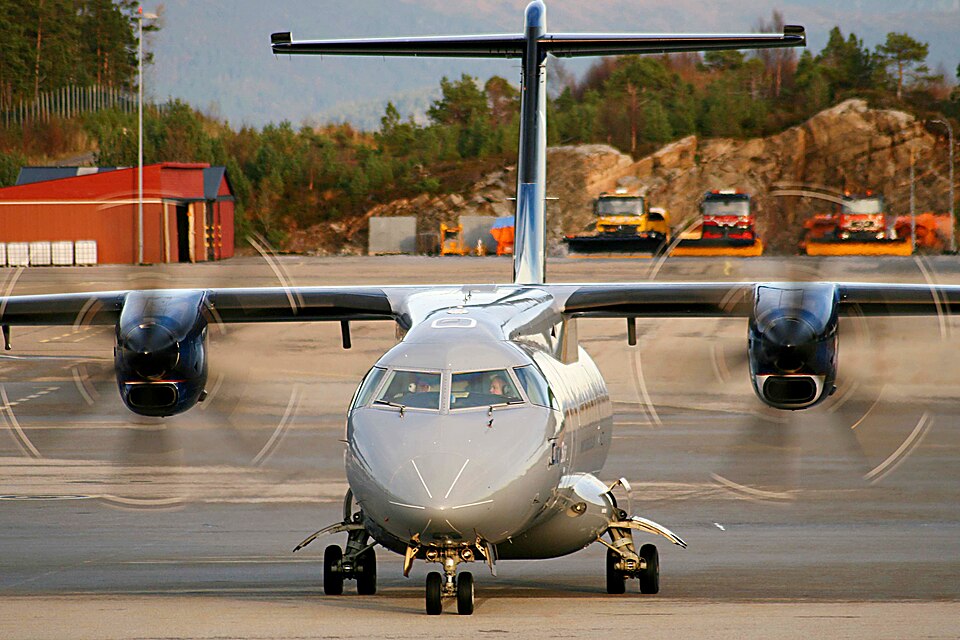
On 11 June 2006, a Dornier 328-100, registration TF-CSB, operated a public transport passenger flight from Aberdeen Airport to Sumburgh Airport in the Shetland Isles. The aircraft was powered by two Pratt & Whitney PW119B turboprop engines and was manufactured in 1997. The flight crew consisted of a very experienced captain (aged 61, with over 18,000 flight hours, including approximately 280 hours on type) and a relatively inexperienced co-pilot in his first commercial flying position. There were also a cabin attendant and 17 passengers on board. No injuries were reported and no damage occurred.
Flight Preparation
The crew reported for duty at 1100 hrs. During pre-flight preparations, they noted that the wind at Sumburgh was forecast from 150°(M) at about 12 kt, making a visual approach to Runway 15 possible. The commander, who would be the handling pilot, discussed with the co-pilot a route inbound that went further west to show local terrain features. The co-pilot recalled the discussion was limited to the possibility of a visual approach. The commander briefed a visual approach to Runway 15, with a waypoint entered into the Flight Management System (FMS) 5 nm west of the Sumburgh VOR/DME, then towards the high ground of Fitful Head before turning right to a right base position for Runway 15. He also briefed the Localiser/DME approach to Runway 09 as a backup.
Incident Sequence
The aircraft departed Aberdeen at 1222 hrs. During cruise, the co-pilot obtained the Sumburgh ATIS report 'Juliet' (1220 hrs): Runway 09 in use, surface wind 150° at 9 kt, visibility 7,000 metres, few clouds at 600 ft. The crew contacted Sumburgh Approach and requested a visual approach to Runway 15, which was approved. They were cleared to descend to 2,100 ft (the Sector Safe Altitude) and instructed to reduce speed to 180 kt due to traffic ahead. As the aircraft descended below 2,100 ft, the altitude alert sounded; the commander asked the co-pilot to silence it. The aircraft continued descending while flying towards Fitful Head. Both crew were visual with the sea surface but not with the coastline or headland. The commander later described the visibility as “thickening haze”.
When the commander decided conditions were not good enough for a visual approach, he began a turn to the right to position for an instrument approach. At that moment, the Enhanced Ground Proximity Warning System (EGPWS) issued a “CAUTION TERRAIN” alert, followed by “TERRAIN TERRAIN PULL UP”. The commander was visual with the terrain and believed the turn would clear it; he did not increase altitude. The co-pilot saw a cliff or steep hill ahead. The landing gear warning siren also sounded as the aircraft descended below 500 ft radio altitude with gear not down. The warnings continued as the aircraft turned eastwards along the cliff line at about 400 to 600 ft. Communication between pilots and ATC was difficult. The co-pilot considered taking control but decided against it. The warnings ceased as the aircraft turned towards the airport, and the landing was uneventful.
Investigation
The AAIB investigation identified a number of organisational, training and human factors issues which contributed to the crew’s incorrect response to the situation. Two recommendations were made concerning crew training and regulatory oversight of the aircraft operator. The incident was captured in part by radar and ATC recordings; the FDR and CVR data had been overwritten, but EGPWS data was successfully downloaded.