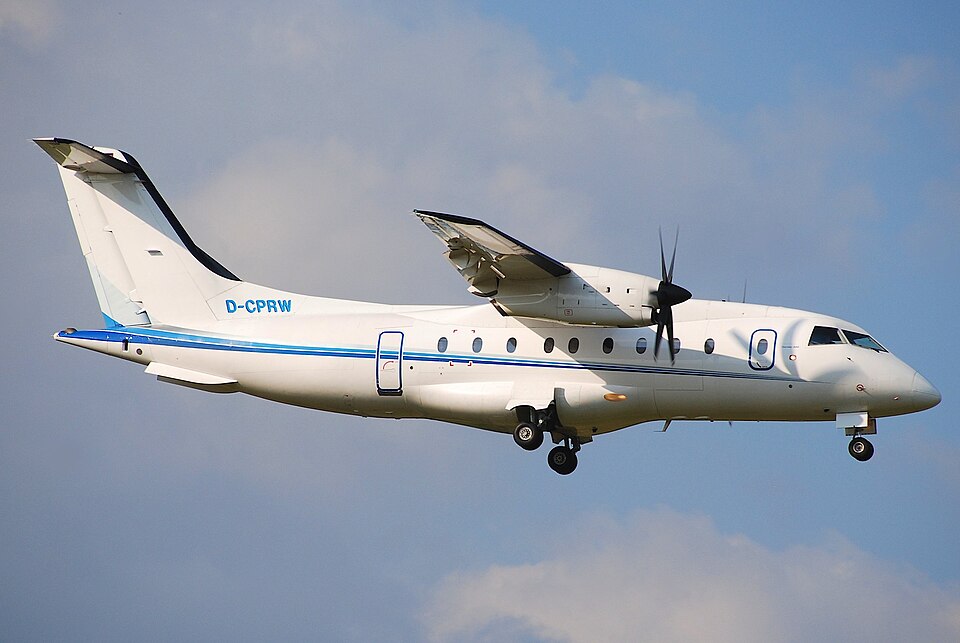
History of the flight
On 18 January 2006, at 1255 UTC, Dornier 328-110 registration D-CPRW was on approach to Runway 24R at Manchester Airport. The aircraft was operating a public transport passenger flight from the Isle of Man (Ronaldsway) Airport, with three crew and 17 passengers on board. No injuries occurred and no damage was sustained.
The crew had reported for duty at 0600 hrs for a four-sector day. The third sector was from Ronaldsway to Manchester; the commander was the Pilot Not Flying (PNF) and the co-pilot was the Pilot Flying (PF). The aircraft was in Instrument Meteorological Conditions (IMC) and being radar vectored by Manchester ATC for an Instrument Landing System (ILS) approach.
The flight proceeded uneventfully until it was downwind for Runway 24R. ATC advised the crew they were 16 miles from touchdown. After acknowledging, a moment of confusion arose when the co-pilot saw the DME indicating 11.4 nm, but the commander clarified that ATC had given track miles and the DME indicated direct distance.
ATC instructed a right turn onto base leg heading 155°(M) and descent from 4,000 ft QNH to 3,000 ft QNH, with a range of 14 miles from touchdown. Subsequently, they were instructed to turn right heading 210°(M), report localiser established, and fly 160 kt until 4 DME. Later, they were instructed to descend to 2,000 ft AMSL and further descent on the ILS. The PNF acknowledged, and one minute later the commander reported established on the localiser at 8.5 nm from touchdown. ATC handed them to Tower frequency.
While configuring the aircraft for landing and reducing IAS to 160 kt, a Mode 5 “GLIDESLOPE” EGPWS alert sounded. The commander took control, disconnected the autopilot, and initiated a go-around; the co-pilot advised ATC. The aircraft had descended to within approximately 450 ft of the ground. ATC provided radar vectors for a second ILS approach, which was completed without further incident.
After shutdown, the commander contacted the ATC Duty Watch Manager and stated they had difficulty capturing the ILS and that the autopilot would not capture the glideslope. A defect report was raised. The Duty Watch Manager submitted a Serious Incident report. The AAIB was notified.
Meteorological information
At 1200 hrs, a broad warm sector covered much of the British Isles including the Manchester area. The ATIS at 1255 hrs indicated visibility 2,800 m in mist, a broken cloud layer at 300 ft agl, and surface wind 270°/10 kt.
Aircraft examination
An integrated maintenance terminal system diagnostic test and functional test of the autopilot and navigational systems were conducted by the company’s maintenance provider and witnessed by the AAIB. No faults or deficiencies were identified in any aircraft systems. ILS test equipment confirmed the system could capture the localiser and that Vertical Speed (V/S) mode would disengage upon glideslope capture. Multiple tests resulted in successful captures. A ground test of the EGPWS was performed; data from previous flights indicated transient faults on flights 5, 6, and 7, and glideslope warnings on flights 2 and 10. The EGPWS unit was removed for data download. A functional test of the VHF navigation system was satisfactory. In summary, no faults were found that would have accounted for the failure to capture the glideslope.
Operating crew’s comments
The crew were interviewed the following day. Both believed they were cleared to descend from 3,500 ft to 3,000 ft as final descent clearance, not from 3,000 ft to 2,000 ft. The co-pilot stated he used V/S mode with approximately 500 fpm during the final approach. The co-pilot also noted a lack of standardisation in Standard Operating Procedures (SOPs) and checklists within the company for the Dornier 328 fleet. He reported using different checklists with different captains, with basic procedures varying between flights. The crew acknowledged this lack of standardisation might have been a contributory factor but stated it was no justification for the incident.
ATC procedures
ATC Director: The Director was unaware of the incident until the following day as he was handing over his position during the go-around. He stated that once an aircraft is established on the ILS localiser, he plans for it to fly level for about one nautical mile before glideslope interception. In this incident, he recalled the aircraft being cleared to 2,000 ft amsl before becoming established on the localiser. He noted that with seven nautical mile spacing (requested by Tower due to poor weather), he could only monitor lateral profiles realistically.
Tower controller: At the time of the incident, the Tower controller was managing departures and arrivals. No further details were provided.
Conclusion
The aircraft systems were found to be functioning correctly. The failure to capture the glideslope was not attributed to a technical fault.