Flight and Initial Approaches
The Dornier 228 departed Lagos (LOS) at 07:00 UTC bound for Eket. En route, the captain briefed the copilot on a northerly wind of 2 knots and a plan to use runway 19 with a Minimum Descent Altitude (MDA) of 500 ft, with a missed approach procedure if the field was not sighted. Cruising at 11,000 ft, the crew began descent about 77 nautical miles from Port Harcourt, near Eket. After clearance to 5,000 ft by Port Harcourt Approach Control, Eket Control descended them to 3,500 ft. At approximately 10 nm from Eket, the NDB frequency was acquired, and the crew informed Eket they were leaving 3,500 ft for 1,500 ft. Overhead the NDB, they initiated the approach. On the outbound leg of 195°, they turned 45° for a right procedure turn while maintaining 1,500 ft. Flap 1 was selected with the speed lever in high RPM. On the inbound track of 105° magnetic, the landing gear was lowered and the aircraft descended to 500 ft.
During the final approach on runway 01, after 90 seconds, the copilot called "runway-in-sight," but the captain thought the aircraft was high and announced an overshoot. The copilot later stated she advised overshoot when the ADF needle swung. A second approach to runway 01 was attempted, maintaining MDA. The runway was sighted from about 2 miles out at 400 ft height. The copilot felt the aircraft was high and called for a missed approach.
Final Approach and Landing
A third attempt was made for runway 19. At between 600–700 ft above the approach path, the captain instructed the copilot: "When you see the field, give me flaps 2, I am going to land." As soon as the copilot sighted the runway at about 2 nm, she selected flap 2. The captain descended for the field. Crossing the threshold, speed was between 95 and 98 knots at a height of 300 ft. The copilot felt the aircraft was high but thought at flap 2 the aircraft was committed to land; she did not warn the captain. The captain stated he descended fast from 300 ft aiming to touch down at about the 6th centerline marking. After touchdown, he applied reverse pitch but felt no deceleration. He then moved throttle levers to maximum reverse, still no deceleration. He applied brakes at about 80 knots but felt only the right brakes were effective, causing the aircraft to skid right. He used opposite rudder but lost directional control. The aircraft overran the end of the paved runway at about 40 knots with brakes still applied.
Damage
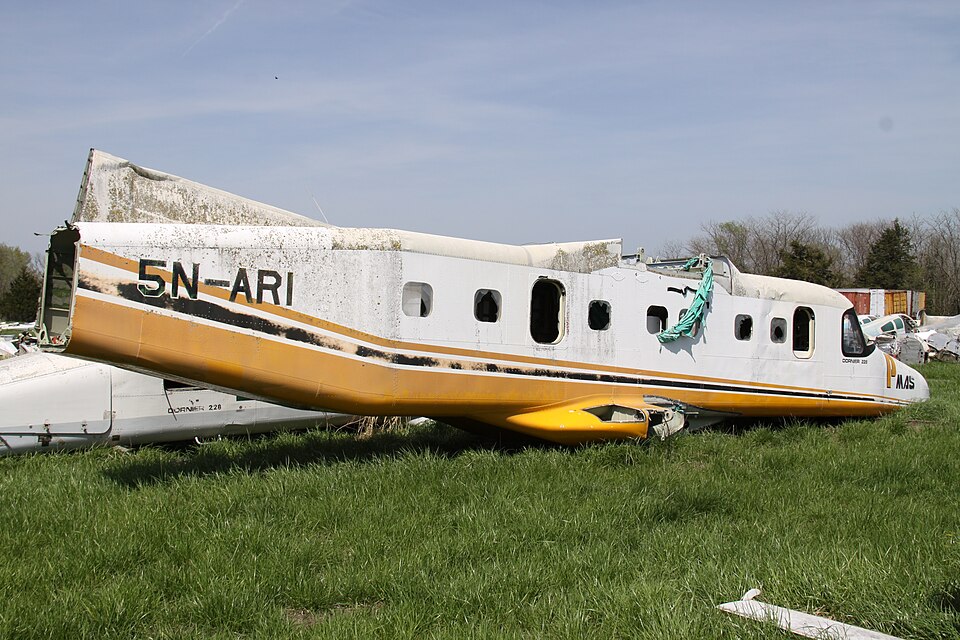
The airplane sustained damage to the wheels and propellers. The fuselage was buckled just forward of the left wing leading-edge and at the fuselage/wing rear attachment point. The right side of the fuselage had buckling at the forward section.
Probable Cause
The accident was probably caused by the failure of the crew to accord due considerations and proper planning to the prevailing weather conditions. This resulted in a long landing, which extended into the unsuccessful braking action. The contributory factor was the emergence of communication breakdown and non display of professional airmanship within the cockpit area, stemming from the company's recommendation to seat a trainee officer on the left seat for at least 100 flying hours, which led to animosity.