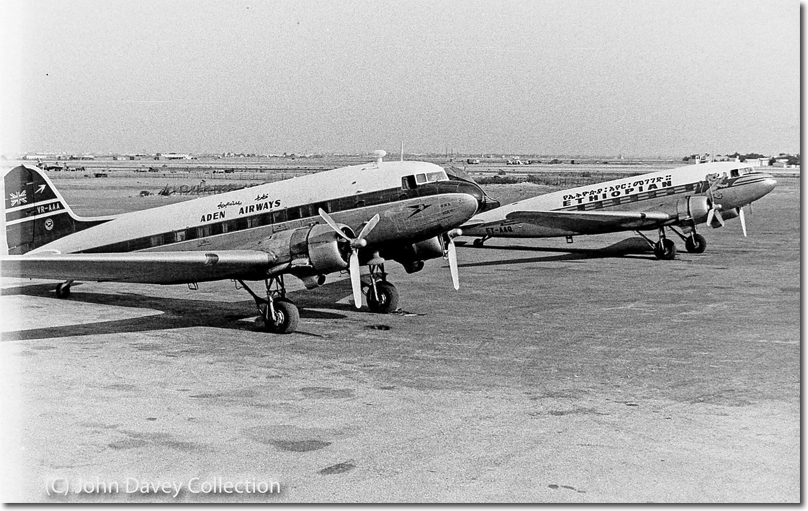
On March 26, 1965, a Douglas C-47 Skytrain (DC-3) (registration VR-AAA) operated by Aden Airways was involved in an aviation accident near Hadibu, Yemen during landing or approach. No fatalities were reported. Investigators recorded the probable cause as: It was determined that the pilot-in-command was no sufficiently familiarized with the airport characteristics and failed to take into consideration the wind component, landing with a tailwind, which was considered as a contributing factor. This summary draws on records from the Bureau of Aircraft Accidents Archives (B3A); 2 related events involving the same aircraft type or operator are linked below.
Aircraft registered VR-AAA. Photo: John Davey / Public domain, via Wikimedia Commons
An airplane landing at Hadibu Airport on Socotra Island veered off the runway after failing to decelerate properly, resulting in a collapsed right main gear. All 17 occupants evacuated safely, but the aircraft was damaged beyond repair.
Incident Overview
After landing at Hadibu Airport on Socotra Island, the airplane encountered difficulties in decelerating properly. As the end of the runway approached, the captain decided to veer off the runway and executed a sharp left turn. During this maneuver, the right main gear collapsed. The airplane then skidded out of control before coming to rest. All 17 occupants were evacuated safely, while the airplane sustained damage beyond repair.
Official Findings
An investigation determined that the pilot-in-command was not sufficiently familiarized with the airport characteristics and failed to appropriately consider the wind component, landing with a tailwind—a contributing factor. It was also reported that the ground equipment was not adapted for the conditions, and the information transmitted to the crew regarding the wind component was improper, both of which were considered contributing factors.
Probable cause
It was determined that the pilot-in-command was no sufficiently familiarized with the airport characteristics and failed to take into consideration the wind component, landing with a tailwind, which was considered as a contributing factor. It was also reported that the ground equipment was not adapted and that the information transmitted to the crew regarding the wind component was improper, which was also considered as a contributing factor.
A SkyWalk Join't 3 paraglider crashed into the ground near Las Vizcachas, Chile, on September 1, 2024. The pilot and passenger sustained serious spinal…
PARAPENTE (ULTRALIVIANO NO MOTORIZADO)·2024-09-01DGAC Chile
A Cessna 172N struck electrical cables while on final approach to land at Aucó Aerodrome in Chile. The pilot was uninjured, but the aircraft sustained damage…
A Bombardier DHC-8-402 suffered a tail strike during landing at Puerto Williams on September 9, 2024. All 76 occupants were unharmed, but the aircraft…
A MYD JS-MD 3 glider veered off the runway and struck a wall at Vitacura Aerodrome on January 6, 2025. The pilot was uninjured, but the aircraft sustained…
A recreational paraglider flight in Puchuncaví, Chile, ended with the pilot sustaining serious injuries after a rapid descent and impact with a hillside on…
PARAPENTE (ULTRALIVIANO NO MOTORIZADO)·2025-03-29DGAC Chile
A Tecnam P2006T landed on its belly at an aerodrome in Poland after the crew failed to confirm landing gear deployment. The incident resulted in no injuries…