History of the flight
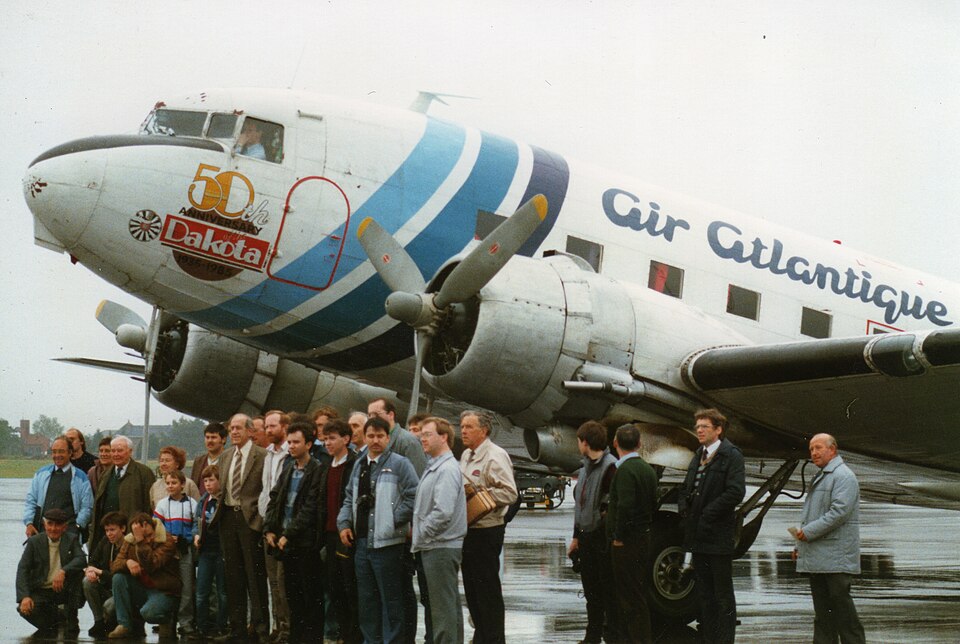
The Douglas DC-3-R-1830-90C, registration G-AMSV, was scheduled to drop poppy petals over a war memorial near Coventry during Remembrance Day weekend on 11 November 2000. The crew comprised two pilots and three dispatchers who would dispense the petals from the rear of the aircraft. The rear crewmembers wore parachutes, and on similar flights in previous years some had parachuted from the aircraft upon return. On this occasion, only one rear crewmember was fit and qualified for parachuting.
The weather forecast for Coventry reported surface wind 230°/20–30 kt and a main cloud base of 1,500 feet with patches at 600 feet above airfield level. It seemed unlikely that the weather would be suitable for parachuting, so no detailed drop briefing was included in the pre-departure briefing.
The poppy drop itself was uneventful. On return to Coventry Airport, the weather appeared improved: surface wind had reduced to 17 kt and no significant cloud below 1,500 feet. The commander spoke with the parachute-qualified rear crewmember, advising him of the improved conditions. The rear crewmember decided to jump provided a height of at least 1,500 feet could be achieved and the aircraft could fly directly into wind.
Upon contacting Coventry ATC, the flight crew requested to "come overhead at 1,500 feet and throw one of our passengers out." The controllers had received no prior notification of a parachute drop and initially regarded the request as a joke. The crew asked if any engines were running on the airfield; informed of a taxiing helicopter, they decided to carry out a "run and break and then come around for another go." About a minute later, the tower controller advised that the helicopter was landing and "...if you want to carry on with the detail." The flight crew acknowledged, and the handling pilot began slowing the aircraft toward a target speed of 80 kt and called for one-quarter flaps.
As the aircraft overflew the airfield, the commander gave the pre-arranged drop signal. Some seconds later, the commander was aware the parachutist had left the aircraft. The commander could not recall the exact IAS at jump time but remembered the strong wind made conditions turbulent.
The parachutist departed facing forward with his right hand on his main pilot parachute and left arm extended for stability. His exit through the rear door was uneventful, but before he cleared the aircraft completely, he struck part of the aircraft, breaking his left arm. His descent immediately became violently unstable, and he fought to regain stability before releasing his parachute. With height rapidly reducing, he attempted to release his reserve parachute with his right hand, but found difficulty operating the deployment pad. At an estimated 200–300 feet, he resorted to deploying the main parachute, but low height and unstable descent prevented full deployment. He landed on his back on a hangar roof with the parachute partially deployed.
Injuries and damage
The parachutist sustained minor injuries: a broken left arm, and injuries to his ribs and internal organs during the impact. The aircraft was not damaged; the hangar roof was damaged.
Background
The DC-3 has been used for free-fall parachuting for many years. Analysis of radar data from Clee Hill (some 40 miles away) indicated the aircraft's ground speed at about the time of the jump was 89 kt (±5 kt). An ATC transmission just before the drop gave the wind at 1,000 feet as 220°/25 kt. Given the aircraft's southwesterly track, this wind would give a minimum true airspeed of 109 kt (107 kt IAS) at the drop point. The aircraft's Certificate of Airworthiness (C of A) states that during parachute dropping, the aircraft must be flown at an IAS of 75 kt (±5 kt) with flaps at one quarter lowered.
The incident aircraft was equipped with a spray bar fitted athwartships beneath the rear fuselage between the rear exit door and tailplane. The parachutist was aware of the spray bar and is certain he did not strike it; he assumes he hit the tailplane. The C of A permits G-AMSV to be used for free-fall parachute jumping and chemical spraying, subject to modifications, but does not state whether parachuting can be undertaken with the spray modification fitted.