Background
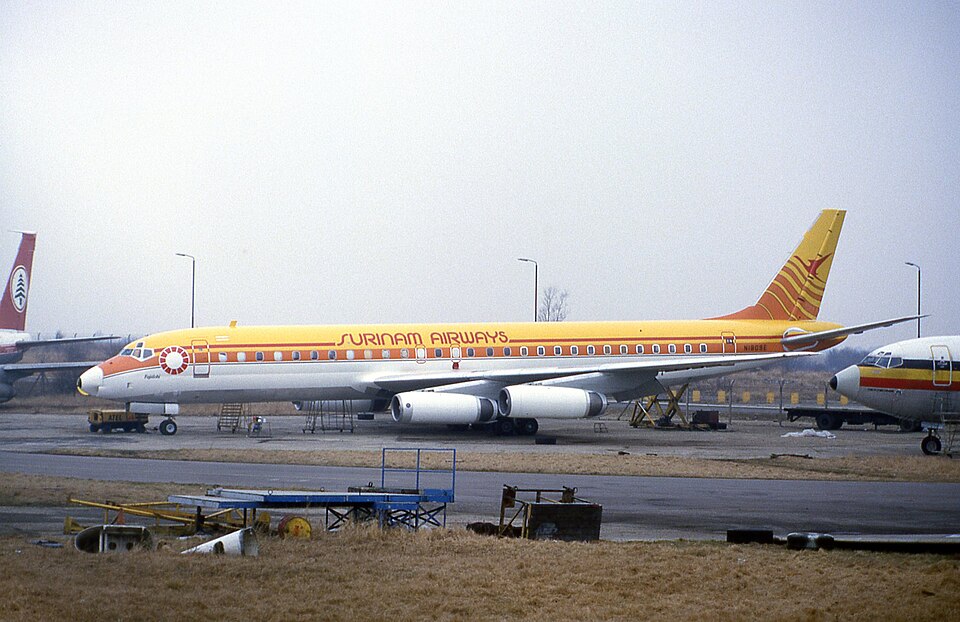
Surinam Airways (SLM) operated regular flights between Amsterdam-Schiphol Airport (AMS) and Paramaribo (PBM) using McDonnell Douglas DC-8-60 aircraft. One of these, registration N1809E, named "Anthony Nesty," was U.S.-registered. Air crew services were provided by Air Crew International (ACI) under a contract that required ACI to supply qualified crew members with FAA certificates meeting regulatory requirements for DC-8 operations. ACI did not arrange proficiency checks, leaving individual pilots to satisfy training and other professional requirements. One captain supplied by ACI had been involved in several incidents on SLM flights; after an investigation, SLM instructed ACI not to use that captain on future assignments. However, he continued to serve as a crew member on multiple flights and was scheduled for accident flight PY764. According to Surinam regulations, a pilot certificate holder cannot act as a pilot in command on commercial flights after reaching age 60. At 66 years old, the captain was not qualified for that role on this flight. Additionally, his most recent proficiency check had been conducted on a GA-7 Cougar twin, not a DC-8.
Flight and Approach
Flight 764 departed Amsterdam-Schiphol at 23:25 (June 6) bound for Paramaribo. The en route portion was uneventful. About 20 minutes before arrival, the crew received weather for Zanderij Airport at 07:00 UTC: wind calm, visibility 900 meters in fog, temperature/dewpoint 22°C/22°C. This contrast with previous visibility of 6 km surprised the crew. Since the instrument landing system (ILS) was not to be used for operational purposes, the copilot stated, "We don't legally have an ILS ... we have to use it," and the captain agreed. The crew believed landing was possible, assuming the fog was localized, as they had sighted the airport during descent. Zanderij Tower cleared the flight for a VOR/DME approach to runway 10. The captain tuned to the ILS and instructed the first officer to set the final approach course for the published VOR/DME approach on the officer's side. During the approach, the first officer reported seeing the airport: "Runway's at twelve o'clock." A minute later, he noted, "A little bit of low fog comin' up I reckon just a little bit," yet still saw the runway and reported it in sight. The DC-8 then entered stratus clouds. The captain told the first officer, "Tell him [tower controller] to turn the runway lights up ... Tell him to put the runway lights bright." The captain attempted to capture the unreliable ILS glide slope signal but failed. The Ground Proximity Warning System (GPWS) sounded multiple times: "Glideslope ... glideslope..." until it was deactivated. The aircraft was flown below the minimum altitude for the ILS/DME approach procedure (260 ft asl) and the minimum descent altitude for the VOR/DME approach procedure (560 ft). The first officer called out, "Two hundred feet."
Collision
Thirteen seconds after the first officer's call, the number 2 engine contacted a tree. The right wing then struck another tree, causing the aircraft to roll, strike the ground inverted, break up, and erupt in fire.
Probable Cause
The official commission determined: (a) that as a result of the captain's glaring carelessness and recklessness, the aircraft was flown below published minimum altitudes during the approach and consequently collided with a tree; (b) an underlying factor was the failure of SLM's operational management to observe pertinent regulations and procedures prescribed in the SLM Operations Manual concerning qualification and certification during recruitment and employment of crew members furnished by ACI.