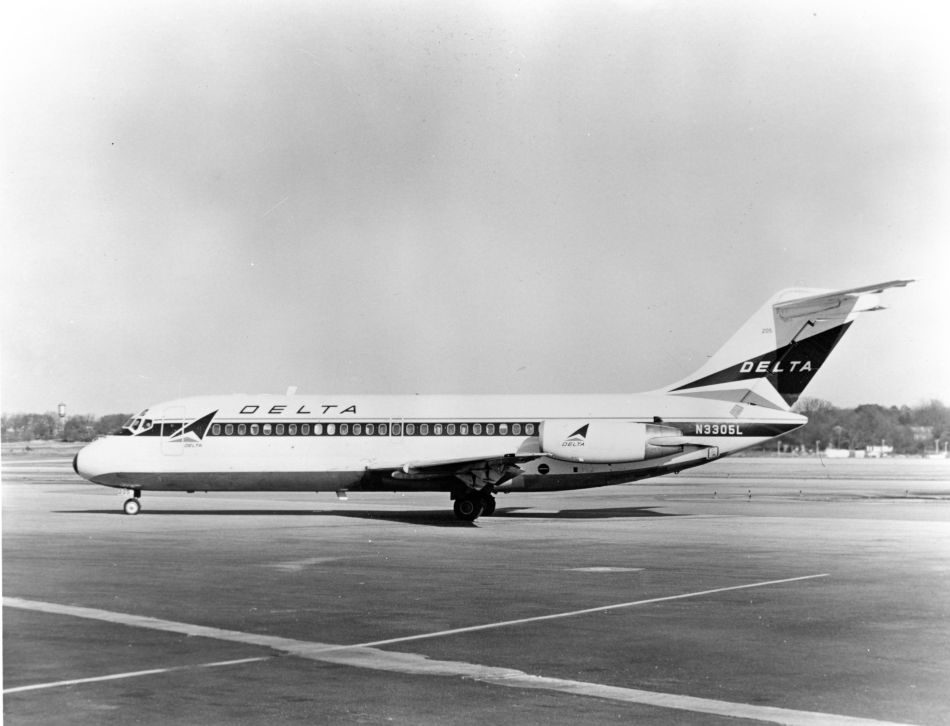
On May 30, 1972, a Douglas DC-9 (registration N3305L) operated by Delta Airlines was involved in an aviation accident near Fort Worth-Greater Southwest (Amon Carter Field), United States of America during landing or approach. 4 people were killed. Investigators recorded the probable cause as: An encounter with a trailing vortex generated by a preceding "heavy" jet which resulted in an involuntary loss of control of the airplane during final approach. This summary draws on records from the Bureau of Aircraft Accidents Archives (B3A); 2 related events involving the same aircraft type or operator are linked below.
Aircraft registered N3305L. Photo: SDASM Archives / Public domain, via Wikimedia Commons
A training flight at Fort Worth-Greater Southwest Airport crashed after an encounter with a trailing vortex from a heavy jet, killing all four crew members.
Accident Details
The accident occurred during a local training flight at Fort Worth-Greater Southwest (Amon Carter Field) Airport. The crew comprised three company pilots and a Federal Aviation Administration (FAA) pilot. Following a normal approach to runway 13, the airplane passed over the threshold when it began to roll left and right. The right wing struck the runway surface, and the airplane rolled out of control to the right, crashing in flames. All four crew members were killed.
Probable Cause
The official probable cause was an encounter with a trailing vortex generated by a preceding "heavy" jet. This encounter resulted in an involuntary loss of control of the airplane during the final approach. Although the crew had been cautioned to expect turbulence, they did not have sufficient information to accurately evaluate the hazard or the possible location of the vortex. Additionally, existing FAA procedures for controlling VFR flight did not provide the same level of protection from a vortex encounter as was provided to flights receiving radar vectors in either IFR or VFR conditions.
A SkyWalk Join't 3 paraglider crashed into the ground near Las Vizcachas, Chile, on September 1, 2024. The pilot and passenger sustained serious spinal…
PARAPENTE (ULTRALIVIANO NO MOTORIZADO)·2024-09-01DGAC Chile
A Cessna 172N struck electrical cables while on final approach to land at Aucó Aerodrome in Chile. The pilot was uninjured, but the aircraft sustained damage…
A Bombardier DHC-8-402 suffered a tail strike during landing at Puerto Williams on September 9, 2024. All 76 occupants were unharmed, but the aircraft…
A MYD JS-MD 3 glider veered off the runway and struck a wall at Vitacura Aerodrome on January 6, 2025. The pilot was uninjured, but the aircraft sustained…
A recreational paraglider flight in Puchuncaví, Chile, ended with the pilot sustaining serious injuries after a rapid descent and impact with a hillside on…
PARAPENTE (ULTRALIVIANO NO MOTORIZADO)·2025-03-29DGAC Chile
A Tecnam P2006T landed on its belly at an aerodrome in Poland after the crew failed to confirm landing gear deployment. The incident resulted in no injuries…