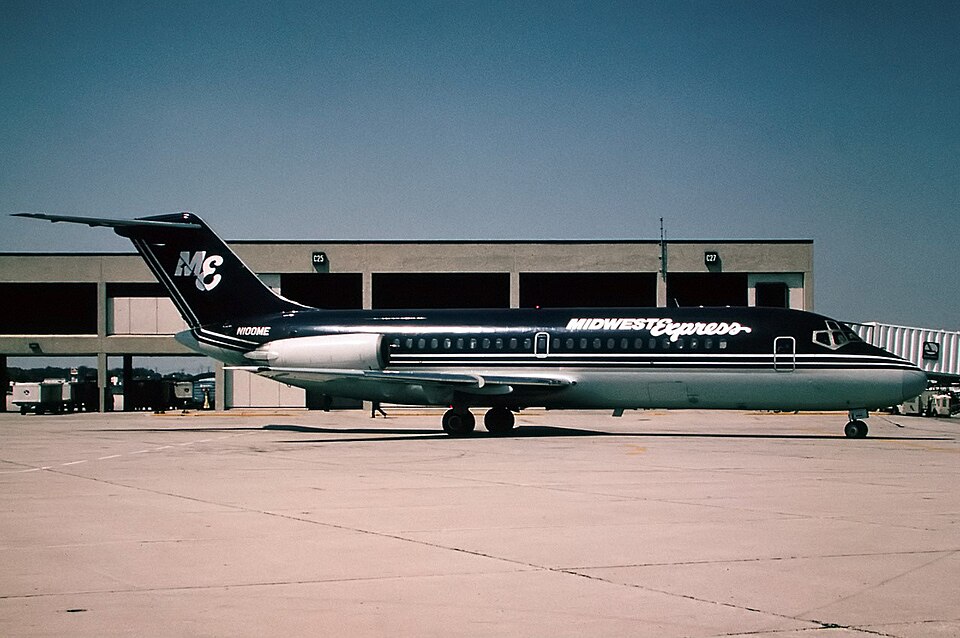
Flight Summary
Midwest Express Airlines Flight 105, a DC-9 registered N100ME, was scheduled to fly from Madison, Wisconsin to Atlanta, Georgia, with an intermediate stop in Milwaukee, Wisconsin. The aircraft had previously operated as Flight 206 from Milwaukee to Madison and returned without incident. On September 6, 1985, Flight 105 departed Madison at 14:25 and arrived in Milwaukee at 14:41. The weather forecast for Atlanta included a 1,000-foot ceiling, visibility 2 miles, thunderstorms, and rain showers.
Sequence of Events
After arriving in Milwaukee, the crew prepared for departure to Atlanta. At approximately 14:49, the first officer requested an instrument flight rules (IFR) clearance, which was received. The before-engine-start checklist was completed at 15:12, engines were started at 15:14, and the after-start checklist was accomplished. The aircraft taxied to runway 19R, with the taxi checklist completed at 15:17:50. The engine pressure ratio (EPR) and airspeed reference bugs were set to 1.91 and 133 knots, respectively. At 15:19:15, the first officer reported ready for departure, and the aircraft was cleared to position and hold. The before-takeoff checklist was completed, and at 15:20:28, the aircraft was cleared for takeoff. The captain was the pilot flying, and the first officer handled communications.
The takeoff roll and liftoff were normal, with liftoff about 4,200 feet from the start of the roll. Rotation occurred at 140 knots, and the aircraft accelerated to 168 knots with a climb rate of about 3,000 feet per minute. At 15:21:26, when the aircraft was about 7,600 feet down the runway and 450 feet above ground, a loud noise was heard, and engine sound decreased. The captain exclaimed, "What the # was that?" The first officer did not respond. The local controller observed smoke and flame from the right engine and instructed a left turn to heading 175. The first officer acknowledged the emergency but did not respond to the captain's subsequent queries. Neither pilot executed the "Engine Failure after V1" emergency procedure callouts. The aircraft deviated right, with heading changing from 194 to 260 degrees in eight seconds. Vertical acceleration dropped to 0.3 G then increased to 1.8 G, and the aircraft stalled at about 156 knots indicated airspeed (KIAS).
Probable Cause
The probable cause, as stated in the official findings, was the flight crew's improper use of flight controls in response to the catastrophic failure of the right engine during a critical phase of flight, which led to an accelerated stall and loss of control of the airplane. Contributing to the loss of control was a lack of crew coordination in response to the emergency. The right engine failed from the rupture of the 9th to 10th stage removable sleeve spacer in the high pressure compressor because of the spacer's vulnerability to cracks.