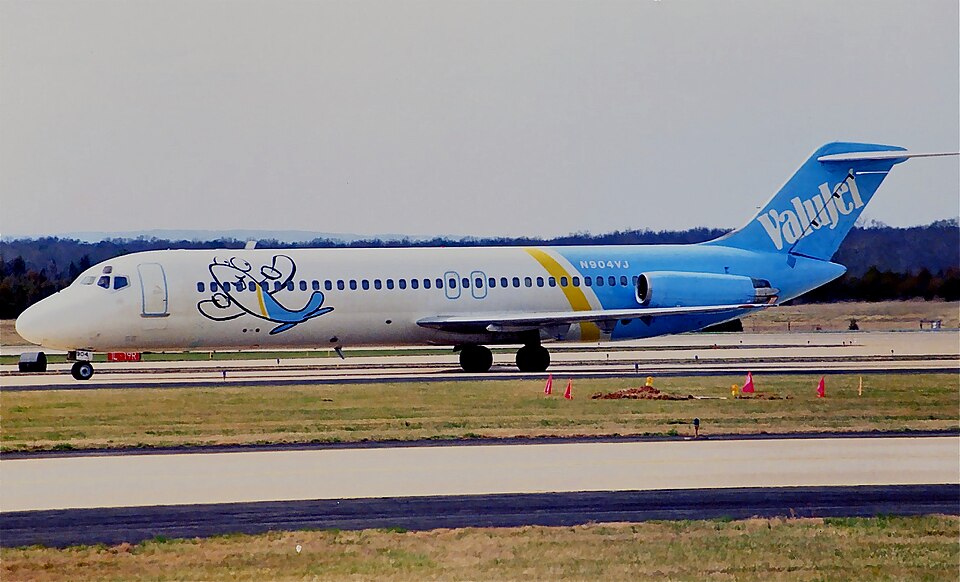
Background
ValuJet Flight 592 was a scheduled flight from Miami International Airport (MIA) to Hartsfield-Jackson Atlanta International Airport (ATL). The inbound flight arrived at Miami at 13:10, delayed from its scheduled 13:00 departure. The flight was to cruise at flight level 350 with an estimated en route time of 1 hour 32 minutes.
Cargo Loading
The DC-9 was loaded with 4,109 pounds of cargo, including baggage, mail, and company-owned material (COMAT). The COMAT consisted of two main tires and wheels, a nose tire and wheel, and five boxes labeled "Oxy Cannisters -‘Empty.’" These boxes were loaded into the forward cargo compartment. The aircraft pushed back from the gate shortly before 13:40 and taxied to runway 09L.
Flight and Emergency
At 14:03:24, air traffic control cleared the flight for takeoff. After departure, the crew climbed as directed. At 14:10:03, a sound was heard, followed by the captain asking "What was that?" At that moment, the aircraft was at 10,634 feet mean sea level, 260 knots indicated airspeed. Soon after, the captain noted an electrical problem and stated they were losing everything. At 14:10:22, the captain said they needed to return to Miami, and shouts of "fire" were heard. The first officer radioed for an immediate return. The controller instructed left turns and descents. At 14:11:12, a flight attendant shouted "completely on fire." The crew requested the closest available airport. The controller provided vectors. At 14:12:45, the controller gave a heading instruction but received no response. The flight data recorder stopped at 14:12:48, with the aircraft at 7,200 feet and 260 knots on a heading of 218 degrees. The radar transponder continued transmitting until 14:13:42, when the aircraft crashed into the Everglades in a right wing down, nose down attitude. No further radio transmissions were received after 14:13:37.
Probable Cause
The National Transportation Safety Board determined that the probable causes of the accident, resulting in a fire in the Class D cargo compartment from the actuation of one or more oxygen generators improperly carried as cargo, were: (1) the failure of SabreTech to properly prepare, package, identify, and track unexpended chemical oxygen generators before presenting them to ValuJet for carriage; (2) the failure of ValuJet to properly oversee its contract maintenance program to ensure compliance with maintenance, maintenance training, and hazardous materials requirements and practices; and (3) the failure of the Federal Aviation Administration (FAA) to require smoke detection and fire suppression systems in Class D cargo compartments. Contributing to the accident was the failure of the FAA to adequately monitor ValuJet's heavy maintenance program and responsibilities, including ValuJet's oversight of its contractors, and SabreTech's repair station certificate; the failure of the FAA to adequately respond to prior chemical oxygen generator fires with programs to address the potential hazards; and the failure of ValuJet to ensure that both ValuJet and contract maintenance employees were aware of the carrier's no-carry hazardous materials policy and had received appropriate hazardous materials training.