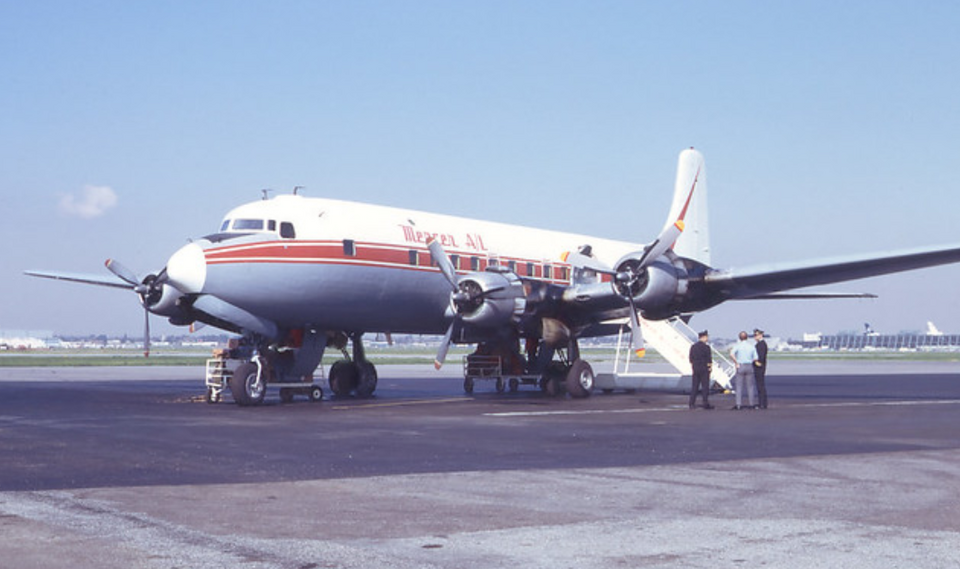
Takeoff and Initial Engine Failure
During acceleration, the flight engineer noted a warning light on No. 3 engine, but no verbal response from other crewmembers was recorded. The aircraft accelerated normally to V1 and V2, rotated, and lifted off without difficulty. Shortly after the captain called for gear and flaps up, a loud noise was heard, and the flight engineer announced the loss of the No. 3 engine.
Propeller Blade Separation
The No. 1 blade of the No. 3 propeller failed, and the resulting imbalance caused almost instant separation of the No. 3 engine from the aircraft. The propeller blade penetrated the lower fuselage and the lower inboard side of the No. 2 engine, severing pneumatic, hydraulic, emergency airbrake lines, and electrical wiring for propeller controls and some engine instruments.
Go-Around and Attempted Landing
The first officer informed the captain of the engine separation. The aircraft continued climbing and began a right turn. An emergency was declared, and the crew received clearance for a landing on runway 07. Debris was discovered on the intersection of runways 07/25 and 15/23, but the pilot decided to continue the approach. The aircraft touched down near the end of runway 07. The captain called for flap retraction and reverse pitch on the propellers. Engine sounds increased, but the first officer advised that the propellers were not going into reverse and to use brakes. As engine noise decreased, the captain reported no response. Maximum power was applied, and the aircraft took off again, clearing the blast fence by approximately 30 feet (9 m).
Diversion to Van Nuys
At 10:39:35, the crew advised Hollywood-Burbank Tower of no brakes and proceeded to Van Nuys Airport (VNY). The crew observed low No. 2 oil pressure and no BMEP indication. Attempts to feather the No. 2 propeller were unsuccessful, and the No. 2 engine stopped with blades at a positive, low pitch angle. Van Nuys cleared the flight for runway 16, but the crew replied they wouldn't make it and requested runway 34. At 10:43:22, the flight was cleared to land on runway 34L.
Forced Landing
While approaching the airport, the aircraft lost altitude and airspeed. The crew realized they could not reach the runway, retarded the throttles, and attempted a forced landing on the Woodley Municipal Golf Course, about 1 mile south of Van Nuys Airport. The aircraft touched down on the main landing gear and bounced three times. The nose struck a 24-inch-high (61 cm) concrete foundation of a partially constructed building. The aircraft came to rest against a nearby house trailer and caught fire about 20 minutes later.
Casualties
Three crew members were killed, and three other occupants were injured.