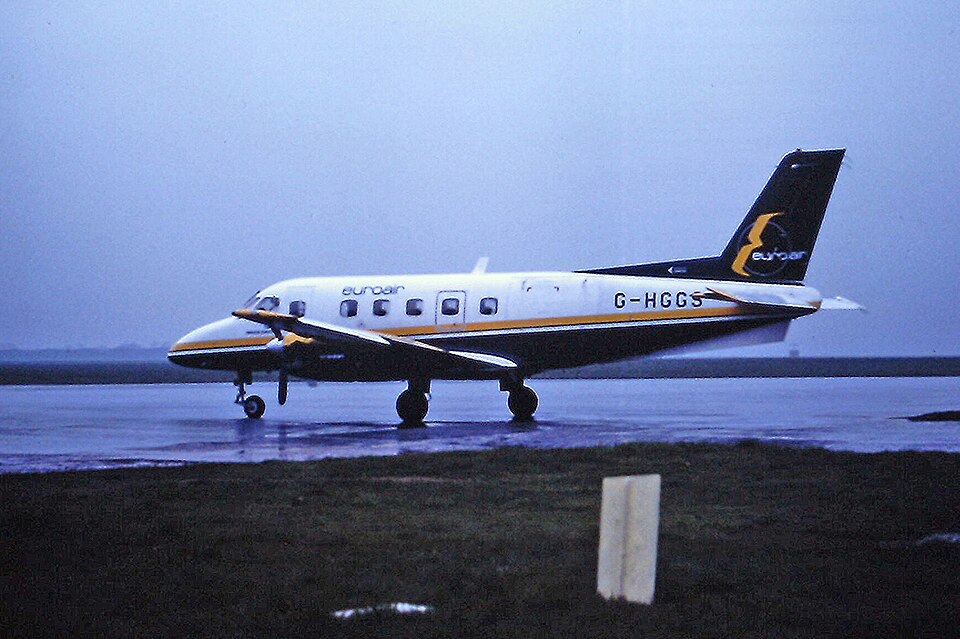
Takeoff and Witness Observations
The aircraft departed at 2055 hours. Air traffic control reported that the takeoff appeared normal. However, three witnesses who were standing outside the terminal buildings stated that the aircraft maintained an unusually level flight path at about 100 feet until it passed behind the buildings and out of their sight.
Subsequent Flight Path
Regardless of the takeoff profile, the aircraft climbed ahead to a position short of Inverness town and then returned on an approximately reciprocal track. It intercepted and followed the 175° radial from the airfield's VOR beacon. Approximately four minutes after takeoff, the aircraft was observed flying in a southerly direction at a level attitude. Its height was unspecified but was low enough to be below the main cloud base.
Accident and Discovery
Less than one minute after that sighting, a "dying orange glow" was seen in the area that later became the accident site. A search was initiated shortly thereafter but was hampered by uncertainty about the aircraft's position. The wreckage was not located until the early morning of 21 November, after the weather had cleared. The aircraft had flown into the side of a hill at an elevation of 1,600 feet above mean sea level. On impact, the aircraft disintegrated and there were only small, localized areas of fire. The pilot, who was the sole occupant, was killed.
Probable Cause
The official findings stated that although various hypotheses could be formulated to fit the observed flight profiles, there was no evidence that would enable a determination of the cause of the accident to be made with any degree of certainty.