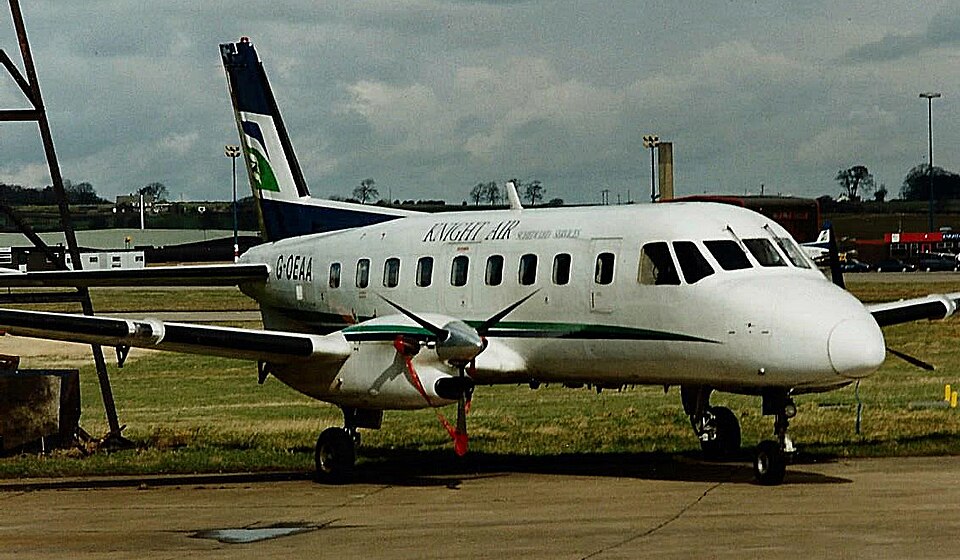
Background
On the morning of 24 May 1995, an aircraft operating a scheduled passenger flight returned to its base at Leeds/Bradford Airport from Aberdeen, landing at 09:44 local time. The crew, not involved in the later accident, reported all systems and equipment serviceable. Routine maintenance was performed, and the aircraft was prepared for a scheduled flight to Aberdeen, designated NE816. It was positioned at the passenger terminal and handed over to the operating crew: a commander in the left seat, a first officer, and a flight attendant. Nine passengers boarded.
Flight and Malfunction
Weather conditions at Leeds/Bradford were poor, with Runway Visual Range reported as 1,100 metres, scattered cloud at 400 feet above the aerodrome elevation of 682 feet, and a light south-easterly wind. Rain was falling, and the airfield had recently been affected by a thunderstorm. The freezing level was at 8,000 feet, with warnings of strong winds and thunderstorms in force. At 17:41, the crew requested permission to start engines. After backtracking the runway, the aircraft took off from runway 14 at 17:47, instructed to maintain runway heading (143° magnetic). Shortly after becoming airborne, the aircraft began a left turn.
One minute and fifty seconds after the start of the takeoff roll, while turning through a heading of 050° and climbing through 1,740 feet amsl, the first officer transmitted to aerodrome control: "Knightway 816 we've got a problem with the artificial horizon sir and we'd like to come back." The controller instructed the crew to maintain a radar heading of 360° and cleared them to 3,000 feet QNH. The instructions were read back correctly, but the aircraft continued its left turn to 300° before rolling into a right turn with approximately 30° of bank.
Attempts to Regain Control
About 20 seconds before the turn reversal, the aircraft was instructed to contact the Leeds/Bradford approach controller. Climbing through 2,800 feet in a steep right turn, the approach controller transmitted: "I see you carrying out an orbit just tell me what i can do to help." The first officer replied: "Are we going straight at the moment sir." The controller informed him that the aircraft was in a right turn, but after further radar returns, reported it was then going straight on a south-easterly heading. The first officer responded: "Radar vectors slowly back to one four then sir please." The controller ordered a right turn onto a heading of 340°, which was correctly acknowledged, but the aircraft began a left turn with an initial bank angle between 30° and 40°. The turn continued onto a heading of 360°, at which point the first officer again asked: "Are we going straight at the moment sir." The controller replied that the aircraft appeared straight. Seconds later, the first officer asked: "Any report of the tops sir." This was the last intelligible transmission from the aircraft.
At 17:52, a brief carrier wave signal was recorded but was obliterated by the controller's request to another departing aircraft for information on cloud tops. The aircraft had reached 3,600 feet, maintaining a fairly constant climb rate and airspeed. The clearance to 3,000 feet had not been amended. After the controller confirmed the aircraft was on a steady northerly heading, it immediately resumed a left turn and began to descend. The angle of bank increased to about 45°, while altitude reduced to 2,900 feet in approximately 25 seconds. As the aircraft passed a heading of 230°, it ceased to appear on secondary radar. Four further primary radar returns were recorded before the aircraft disappeared from radar.
Collapse and Breakup
Residents near the accident site reported dark and stormy conditions. Several witnesses described engine noise as pulsating or surging, then fading just prior to impact. Other witnesses saw a fireball descending rapidly out of the low cloud base; one witness saw the aircraft in flames before it struck the ground. All occupants died at impact. Examination revealed that at a late stage in the descent, the aircraft broke up, losing a large part of the right wing outboard of the engine and the right horizontal stabiliser. There was some disruption of the fuselage before ground impact. The airborne structural failure resulted from flight characteristics beyond the design limits of the aircraft following loss of control shortly before impact.
Investigation Findings
The investigation identified the following causal factors:
- One or, possibly, both of the aircraft's artificial horizons malfunctioned, and in the absence of a standby horizon (for which there was no airworthiness requirement), there was no single instrument available for assured attitude reference or simple means of determining which flight instruments had failed.
- The commander, who was probably the handling pilot, was initially unable to control the aircraft's heading without his artificial horizon and was eventually unable to retain control of the aircraft while flying in IMC by reference to other flight instruments.
- The aircraft went out of control while flying in turbulent instrument meteorological conditions and entered a spiral dive from which the pilot, who was likely to have become spatially disoriented, was unable to recover.