Background of the F15E Flight
Two US Air Force F15E Eagle aircraft, each crewed by a pilot and a weapons system officer, departed RAF Lakenheath, Suffolk, at 0948 hrs on a close air support training sortie to Otterburn Range, about 20 nm north-west of Newcastle. The formation commander, call sign Tahoe 51, led his wingman, Tahoe 52. The sortie was planned with an Allocated Sortie Duration of 1.3 hours and a nominated diversion airfield of RAF Valley in Anglesey, Wales. BINGO fuel, the minimum fuel to return to base and divert if necessary, was set at 10,000 lb.
Fuel Concerns During the Sortie
After about 25 minutes of the exercise, Tahoe 52 reported approaching BINGO fuel. The formation commander reduced BINGO to 9,000 lb to allow one more run at 20,000 ft during the climb to cruising altitude. Approximately 10 nm from the target, Tahoe 52 reached the new BINGO level, but the commander decided to complete the run, estimating an additional burn of only 200-300 lb. After the final run, the aircraft climbed to FL240 and flew toward Lakenheath at 320 KCAS. Shortly after, Tahoe 52 requested a slower speed to conserve fuel, as his flight management system indicated arrival at Lakenheath with 5,800 lb, below the 6,900 lb diversion fuel. The commander planned a minimum power descent to save fuel.
Air Traffic Coordination and Diversion Decision
Between 75 and 100 nm north of Lakenheath at about 1105 hrs, the formation commander contacted the Supervisor of Flying (SOF) for weather, learning conditions were worsening. The ATIS reported cloud base at 1,200 ft aal, with some at 800 ft aal. Initial contact with Lakenheath ATC was at 1116 hrs. The aircraft were in VMC above a cloud layer and given a radar information service. Concerned about low fuel, at 1121 hrs the commander asked about delay and was told there would be none. The formation was vectored onto downwind. At 1122 hrs, they requested a radar advisory service as they neared IMC. The commander obtained another weather update; cloud base was 300-500 ft aal. The SOF later recommended diverting to RAF Valley. At 1129 hrs, Tahoe 52 informed ATC of diversion to Valley, turning onto 291°. The aircraft were then about 25 nm west of Lakenheath, descending through 5,000 ft, with Tahoe 52 having about 5,000 lb of fuel and the commander about 5,500 lb.
Climb and Encounter with the Embraer
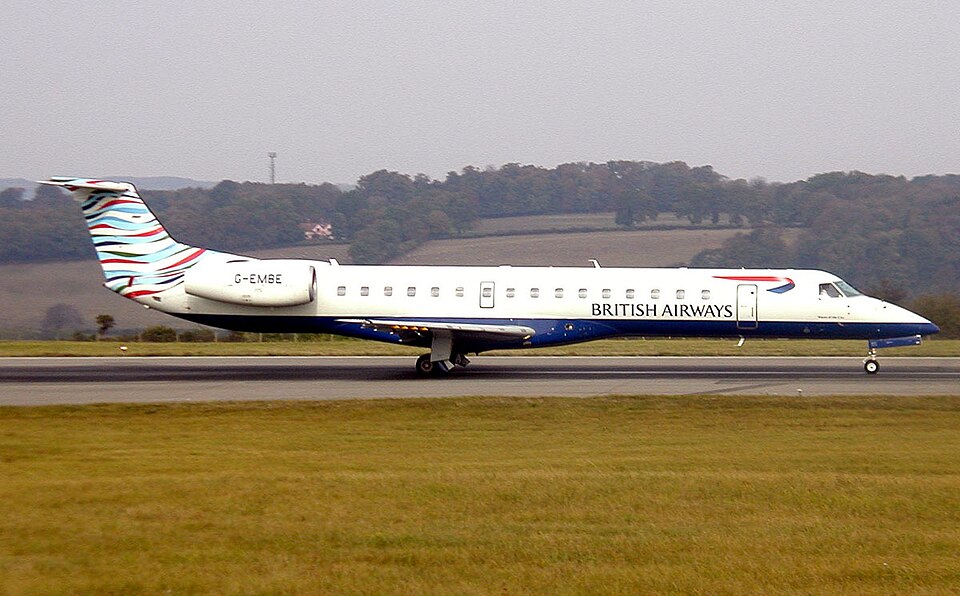
After a change in lead aircraft and transponder squawk, the formation commander instructed Tahoe 52 to climb at maximum dry power to FL240, then to advise fuel requirements for diversion. The commander himself began climbing at about 5,000 ft/min, aware of controlled airspace at FL195. He increasingly needed to contact London Military Radar for airways crossing clearance. At 1131:33 hrs, Lakenheath Arrival handed the formation to London Military. The commander instructed his wingman to change to frequency 254.825 MHz, but mistakenly transmitted 254.025 MHz. Neither crew noticed the error. Radar records showed Tahoe 52 climbing through FL160. The Embraer EMB-145EU (G-EMBE), a public transport aircraft with 4 crew and 35 passengers, was cruising on Airway P155 at FL210. The aircraft commander reported seeing a military fighter pass close in front. Investigation identified the conflicting aircraft as one of the two F15Es, which had climbed above their cleared level. The minimum distance recorded was 0.53 nm; vertical separation could not be determined.
Aftermath
No injuries or damage were reported. The incident was investigated by the AAIB.