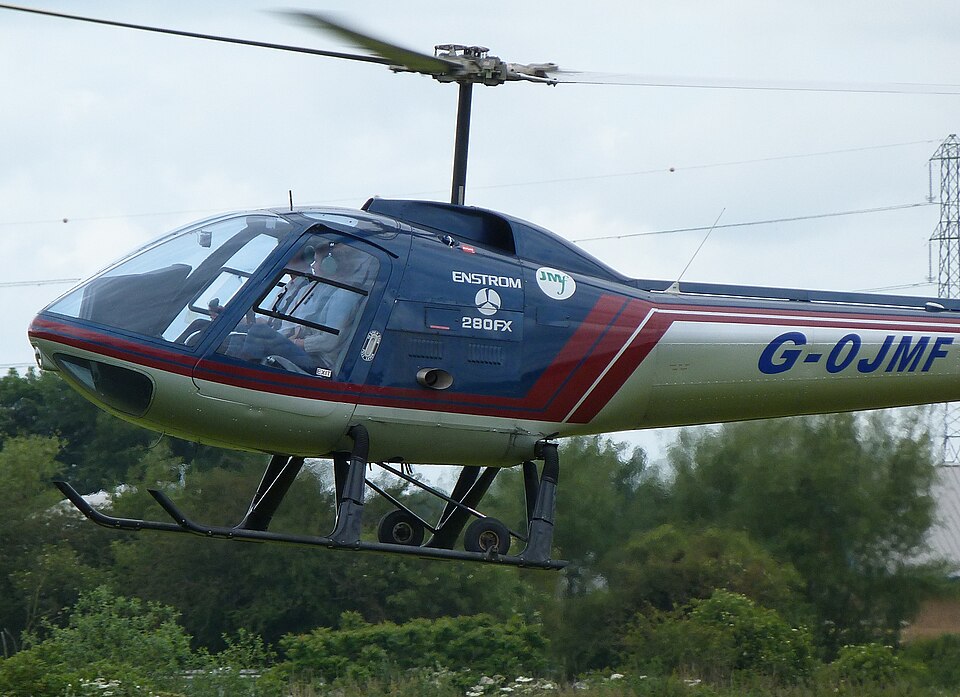
Accident Overview
On 8 February 2012 at 1425 UTC, an Enstrom 280FX Shark (registration G-OJMF) operated as a training flight experienced a tail rotor control failure during approach to Manchester Barton Airport. The pilot conducted a run-on landing on grass Runway 14. The helicopter veered right after touchdown and encountered rough, frozen ground, causing it to bounce and the tail rotor to strike the ground. The aircraft sustained damage to the tail rotor assembly, rear fuselage, and left landing gear skid. Both crew members were uninjured.
History of the Flight
The pilot was conducting a navigation exercise when, at the first turning point, he perceived a lack of full tail rotor authority, specifically no response to left pedal inputs. He made a gentle right turn and elected to return to the airfield, approximately 20 nautical miles distant. He transmitted a PAN call and decided to perform a run-on landing. Although the initial touchdown was straight, the helicopter veered to the right and encountered rough, frozen ground at the side of the runway, leading to the tail rotor strike.
Damage and Injuries
Damage was limited to the tail rotor, rear fuselage, and left landing gear skid. No injuries were reported among the two crew members. The aircraft had accumulated 570 operating hours since new in 1999 and was parked outdoors at its operating base.
Investigation Findings
After the accident, it was noted that the yaw control cable on the left side of the tail boom had been severed. The helicopter manufacturer commented that such cable severance in flight was rare and only associated with violent manoeuvres; in this case, the cable was cut due to landing damage. Disassembly of the tail rotor revealed that the flange on the inboard end of the bronze pitch change bearing had broken off and was missing. The separated portion would have had to break into several pieces to not be retained on the shaft. The manufacturer stated they were unaware of any previous bearing failures of this nature.
Bearing Analysis
The bearing, manufactured from sintered bronze (oil-impregnated AMS 4805), was examined metallurgically. A crack was found in a corner of one of the keyways within a stained region of the fracture. The crack had propagated through the wall thickness and extended axially for approximately 5 mm. The fracture surface showed intergranular features consistent with sintered material. Scanning electron microscopy revealed ductile dimples in clean areas, indicating overload, while the stained region exhibited corrosion products, including chlorine, likely from atmospheric moisture. Density and porosity measurements gave values of 6.21-6.25 g/cm³ and 31% porosity. The available evidence indicated that the bearing failed in flight: the flange detached, causing loss of left yaw control. Approximately one-third of the bearing circumference had pre-existing cracking with corrosion prior to the flight, while the remaining fracture was ductile overload occurring during the incident. The step in the overload region suggested two crack fronts propagating from either end of the stained region.