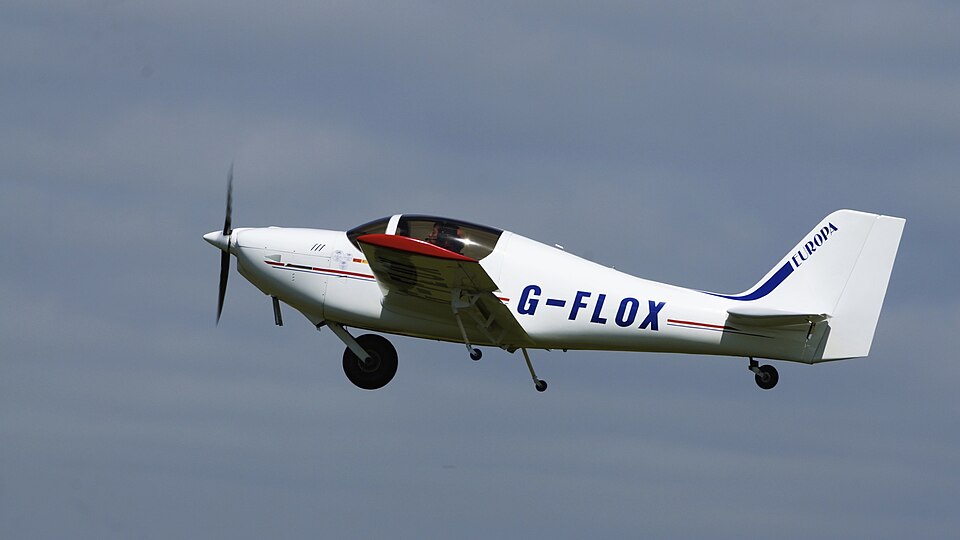
Incident Overview
On 5 October 1999, at approximately 1335 UTC, a Europa aircraft, registration G-FLOX, made a forced landing after takeoff from Redhill Aerodrome, Surrey. The pilot, who held an Airline Transport Pilot's Licence with 7,600 total flying hours (9 on type), had just performed a touch-and-go on Runway 08R. During climb out at about 150 feet agl, heavy engine vibrations prompted an immediate forced landing within the aerodrome boundary. The sole pilot and one passenger were uninjured, but the aircraft sustained damage to the propeller and outrigger, along with a small split in the fuselage shell.
Aircraft and Propeller Details
The Europa was powered by a single Jabiru 2200A piston engine. The propeller was a modified two-bladed wooden design, originally supplied by the engine manufacturer but reworked to optimise performance for the Europa/Jabiru combination. The manufacturer had developed a scheme for altering blade pitch by adding fibreglass layers to the blades and grinding them to the desired profile. However, the propeller in question was a trial unit that differed from the production scheme in several respects. It had four layers of crossweave fibreglass on the front of each blade and three on the back.
Propeller Examination
Examination of the propeller revealed that a section of the fibreglass skin from the front surface of one blade had detached in flight. The detached skin was found near the upwind end of the runway, about 500 metres from where the aircraft came to rest. No abrasion or damage was evident at its tip, indicating that the propeller had not contacted the runway during the go-around. Tip damage on the remaining propeller was consistent with the forced landing.
The core wooden propeller had polyurethane leading edge inserts for erosion protection over the outer two-thirds of each blade. On the lower surface, the insert was stepped above the wood, with glass fibre butting against it; on the front surface, the polyurethane was faired and overlaid by fibreglass. Investigation identified three areas of suspect bonding:
- Hub region: Resin puddling and lack of fibreglass wetting indicated insufficient pressure during curing. Some fractured resin suggested partial adhesion, likely secondary to the detachment.
- Trailing edge: Resin adhered to the wood but poor fibreglass wetting indicated a weak bond, though tearing of resin suggested secondary rupture.
- Leading edge (3-15 cm from tip): Resin was present and wetted the fibres, but the exposed surfaces were very smooth, indicating no actual bonding. Small voids were also seen. This area was directly behind the polyurethane leading edge insert. The faired edge of the fibreglass that had covered the polyurethane detached completely, leaving none on the polyurethane. It was noted that the feathered edge at this location would be vulnerable to disbonding from flexural and impact loads.
Additionally, the black paint applied to the propeller for rain protection (instead of a wrap-around leading edge strip) may have contributed to resin softening or thermal expansion stresses under direct sunlight.
Manufacturer's Response
The manufacturer subsequently changed procedures for reworked propellers. The polyurethane leading edge strip is now removed and remoulded after blade re-profiling to cover the edge of the fibreglass. Black paint is discontinued in favour of a clear finish to allow easy detection of stone impact damage. The Popular Flying Association also advised inspectors to be particularly vigilant when inspecting propellers of this type.