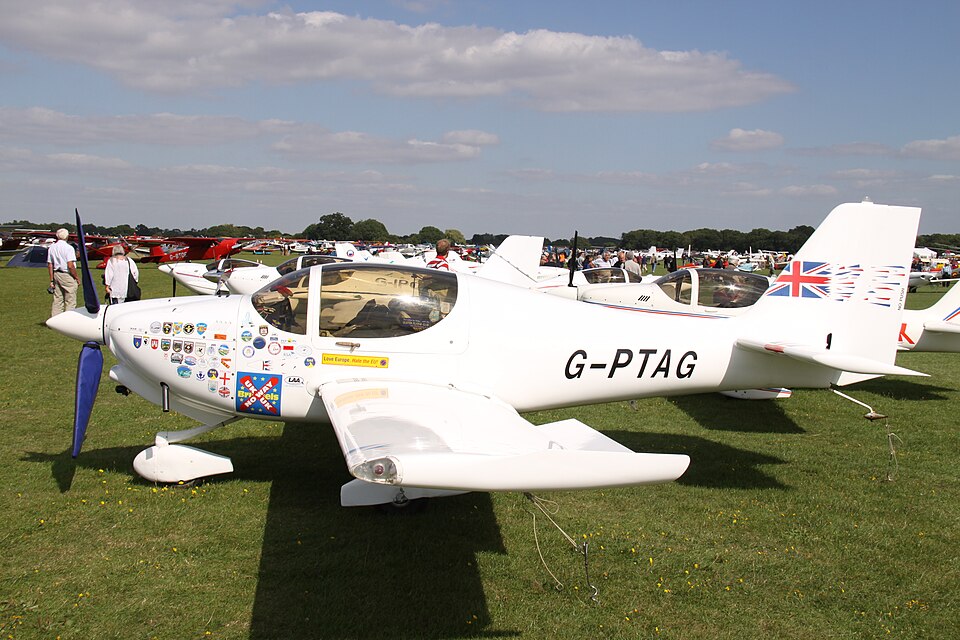
History of the Flight
The aircraft, a tri-gear Europa registered G-PTAG, was returning to Wickenby after a flight to Shobdon. The pilot reported a smooth touchdown on Runway 34, initially on both main wheels, followed by the nosewheel. Shortly after the nosewheel settled, it shimmied and detached together with the nosewheel fork. The propeller struck the runway, and during the subsequent ground roll, the nose gear leg became angled rearwards, allowing the aircraft to adopt an extreme nose-down attitude. The forward underside of the main wheel spats contacted the runway. The lower cowl, propeller, nose gear leg, nose gear mount, and main gear fairings were damaged. The pilot and passenger were uninjured. The pilot recalled a long taxi on grass at Shobdon prior to the flight with no problem.
Description of the Nose Gear
The Europa is a two-seat kit aircraft. G-PTAG was a tri-gear version. The nose gear leg was a steel tube attached behind the engine compartment, swept forward at approximately 30° to the horizontal. The nosewheel fork assembly, supplied pre-assembled, consisted of a pivot shaft and an aluminum alloy fork unit. The upper end of the pivot shaft fitted into a cylindrical housing welded to the lower end of the nose gear leg. The lower end of the pivot shaft fitted into a hole in the fork unit. Tolerances allowed a gap of 0.0016 inches to 0.0002 inches interference. Loctite adhesive bonded the components. A 6 mm diameter scroll pin inserted through holes in both the fork and the pivot shaft positively located the components and took the load from tightening the shimmy damper nut.
Examination of the Nose Gear
After the incident, the nose gear leg and fork assembly were examined at the AAIB headquarters. The scroll pin had failed in shear due to overload. The hole in the pivot shaft for the scroll pin was not drilled accurately across the diameter and was not perpendicular to the axis, introducing asymmetric loading. Burrs were present on the internal surface next to the hole. The lower end of the pivot shaft had expanded the upper part of the hole in the fork, likely occurring after the scroll pin failed. The spring washers from G-PTAG showed wear and were over 10% lower in height compared to new parts, possibly due to overloading.
Previous Incidents
Three years prior, the aircraft had landed heavily nosewheel-first, deforming the nose gear leg, which was replaced. The fork was inspected and fitted to the new leg. On 7 June 2005, another tri-gear Europa (G-PUDS) suffered a similar scroll pin failure in shear from a downward load.
Manufacturer's Testing and Recommendation
The manufacturer tested a nosewheel assembly and found that 17 ft lbs of torque compressed the spring washers completely, and the scroll pin withstood 40 ft lbs without marking. The precise cause of the scroll pin failure in G-PTAG could not be determined. However, evidence suggested that the design and manufacture could be made more robust. Safety Recommendation 2006-146 was issued: that Europa Aircraft Limited review the design, manufacture, and recommended maintenance of the nose gear fork assembly to improve integrity. Subsequently, Europa revised the pivot shaft design to increase insertion length and reduce load on the scroll pin, and specified a new material for the casting.