Incident Details
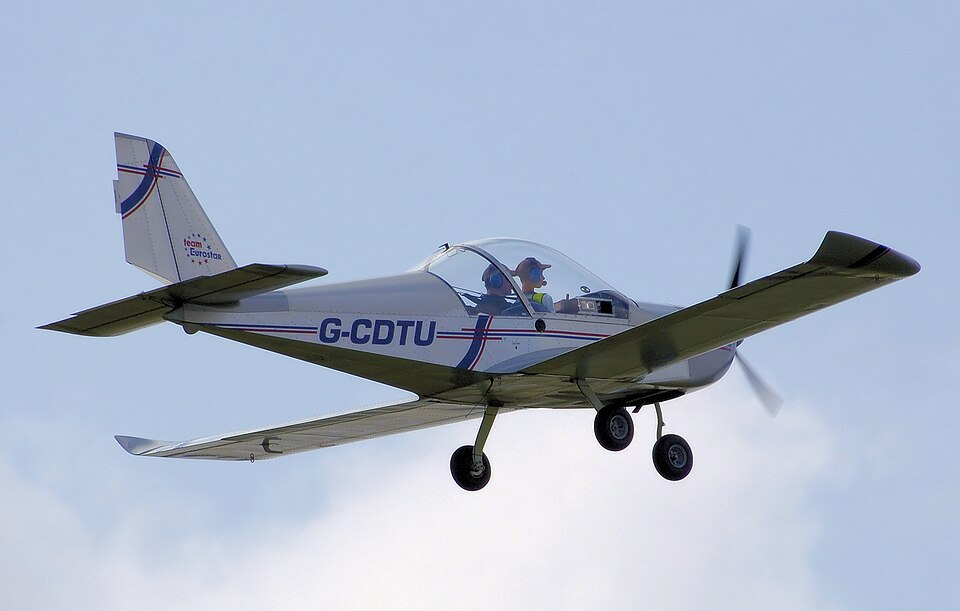
On 27 May 2012 at 1400 UTC, a student pilot flying an EV-97 TeamEurostar UK, registration G-CDTU, was conducting a qualifying cross-country exercise at Arclid Airstrip near Sandbach, Cheshire. The wind was from 120° at 8 to 9 kt. The pilot executed a landing on Runway 20 with a smooth round-out and applied right rudder to correct for drift caused by the crosswind.
Sequence of Events
Upon touchdown, the pilot held the stick back and centred the rudder in preparation for lowering the nosewheel. At that point, the aircraft weathercocked to the left, possibly due to a gust. When the pilot attempted to compensate by applying right rudder, it was ineffective because of the low speed. With the nose still raised, the aircraft departed the left side of the runway and entered a ploughed field. The rough terrain caused the nosewheel to bend rearward and the propeller to strike the ground.
Aircraft and Pilot Information
The aircraft was a 2005 EV-97 TeamEurostar UK, powered by a single Rotax 912-UL piston engine. The student pilot, aged 49, had a total flying experience of 29 hours, all on type, with 9 hours in the last 28 days. There was one crew member and no passengers on board. The pilot reported no injuries.
Damage
The accident resulted in damage to the nosewheel, fuselage underside, wingtip, engine cowling, propeller, and main wheel fairings.
Pilot's Comments
The student noted that the experience taught him the importance of lowering the nose earlier during landing to maintain control, as rudder effectiveness diminishes at low speeds.