History of the Flight
The pilot, holding a Private Pilot’s Licence (Microlights) with 454 total hours (82 on type), planned a flight to Sandown Airfield on the Isle of Wight with one passenger. Weather conditions were good with a light southerly wind, scattered clouds at 3,000 feet, and visibility greater than 10 km. The initial takeoff roll from Runway 18, a grass strip, was normal. The aircraft had a tendency to turn left due to propeller slipstream and torque effects, which the pilot compensated for by applying right rudder pedal. Before normal liftoff speed, the aircraft pitched nose-up earlier than expected, surprising the pilot. To prevent a premature liftoff, he lowered the nose back onto the ground. The nosewheel did not touch heavily, but the aircraft began a rapid left turn at about 30 to 35 mph. The pilot could not correct the turn in time, and the left wingtip struck high grass in an adjacent field. The aircraft spun almost 180 degrees to the left, causing the right main landing gear leg to separate, the nose gear to collapse, and the propeller to hit the ground. The pilot and passenger exited unassisted, with no injuries.
Description of the Aircraft
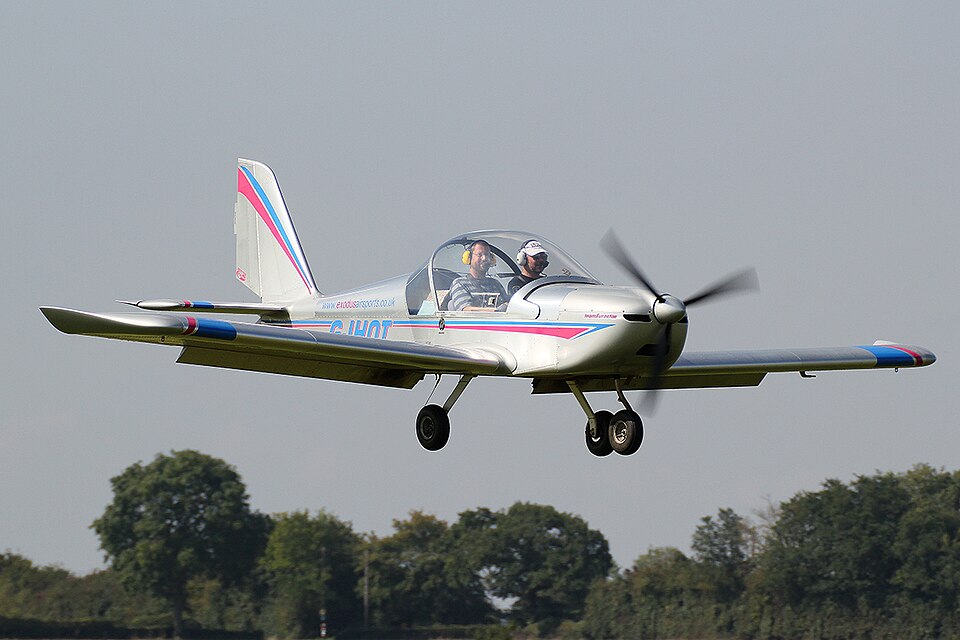
The EV-97 TeamEurostar is a kit-built, all-metal fixed-wing microlight with tricycle landing gear, manufactured by Evektor-Aerotechnik. G-IHOT was assembled by Cosmik Aviation Ltd in the UK and sold as a ready-to-fly aircraft with a Permit to Fly. The steerable nosewheel is controlled by rudder pedals: left pedal turns left, right pedal turns right. The aircraft also has toe-operated hydraulic brakes for differential braking.
Analysis
In the pilot’s honest and open report, he stated the basic cause was his ‘failure to make an immediate and appropriate correction to the left turn as soon as this turn became apparent.’ He learned to fly on flex-wing microlight aircraft, where pedal steering is opposite: left pedal results in a right turn on the ground, and right pedal results in a left turn. The pilot noted that ground controllability was the biggest difficulty when converting to fixed-wing microlights. He considered it possible that he inadvertently applied left pedal to correct the left turn, though he had no recollection of doing so. His surprise at the early pitch-up and the suddenness of the turn when the nosewheel was lowered likely contributed to an incorrect or delayed pedal input. The pilot believed the early pitch-up was probably caused by holding the stick too far aft during the initial ground roll.