TCAS RA triggered by near-collision during ATC training session at Turin

Casualties unknown • CTR Torino, IT

A serious airprox occurred near Turin Caselle airport when two approaching aircraft converged on the same altitude, triggering TCAS resolution advisories.

What happened

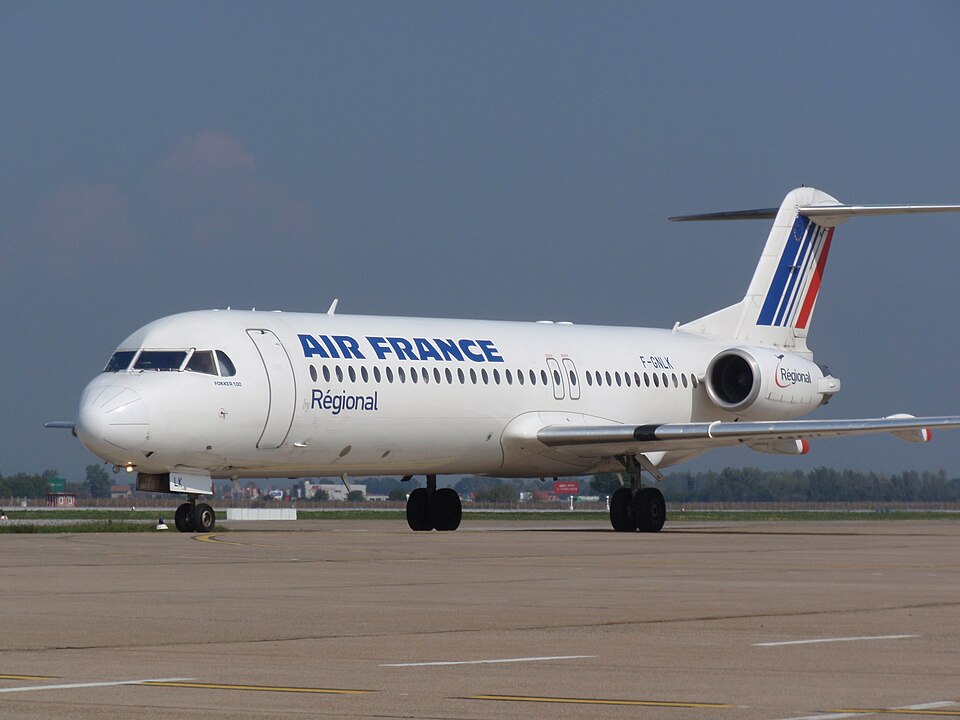
On January 6, 2005, at approximately 10:08 UTC, a serious airprox occurred within the Turin CTR involving two passenger flights approaching runway 36 at Turin Caselle Airport. The first aircraft, a Fokker 100 (F-GNLK) operated by Regional CAE, was arriving from Paris, and the second, a Fokker 50 (PH-FZG) operated by Denim Air, was arriving from Barcelona.

During the approach, the two aircraft were being vectored for an ILS final. While the aircraft were at altitudes between 4,700 and 4,400 feet, their trajectories converged. The lateral separation between the two aircraft reduced from 3 NM to just under 1 NM. At the closest point of approach, the aircraft were at the same altitude and separated by only 1.04 NM. The conflict was resolved through the combined intervention of the pilots following TCAS resolution advisories and instructions from the air traffic controller.

The investigation

The ANSV investigation focused on the actions of the air traffic control (ATC) unit, which was conducting an On-the-Job Training (OJT) session. At the time of the event, a trainee controller was managing communications under the direct supervision of an instructor.

The investigation examined radar data and voice communications. A discrepancy was noted in the radar data timing, where a 10-second advance was observed in the data logs compared to the actual communications, likely due to a data transfer anomaly. The investigators also looked into the possibility of "label swapping," a phenomenon where radar labels for two nearby aircraft momentarily switch identities. While the controllers reported such a swap occurred, the investigation could not definitively confirm this due to the implementation of a new radar system at the facility before the data could be fully verified.

Findings

  • The primary cause was an inadequate assessment of the operational scenario by the ATC instructor. In an attempt to demonstrate complex maneuvering capabilities to the trainee, the instructor implemented a sequence that was too complex for real-world traffic, attempting to use the significant speed difference between the two aircraft to reorder the arrival sequence.
  • The instructor's desire to use the training session to practice complex vectoring led to a high-risk setup that did not account for the difficulty of maintaining separation with such disparate speeds.
  • A contributing factor may have been the momentary swapping of radar labels, which could have led to incorrect instructions, though this remains unconfirmed.
  • The significant speed differential (exceeding 100 knots) between the two aircraft contributed to the loss of separation as the faster aircraft closed in on the slower one.

Probable cause

The event was caused by the inadequate evaluation of an operational scenario during a training session, where the instructor's attempt to demonstrate complex traffic management led to an unsafe approach configuration.

Frequently asked questions

What happened in the 2005-01-06 Fokker 100 accident near CTR Torino, IT?

A serious airprox occurred near Turin Caselle airport when two approaching aircraft converged on the same altitude, triggering TCAS resolution advisories.

What aircraft was involved and where did it happen?

The accident on 2005-01-06 involved a Fokker 100, registration F-GNLK, at CTR Torino, IT.

What was the probable cause of the accident?

The event was caused by the inadequate evaluation of an operational scenario during a training session, where the instructor's attempt to demonstrate complex traffic management led to an unsafe approach configuration.

Investigation report by the Italian National Flight Safety Agency (ANSV). Original record: https://ansv.it/wp-content/uploads/2021/08/F-GNLK.pdf. This page is a structured re-presentation; facts and quotes are in the Agenzia Nazionale per la Sicurezza del Volo (ANSV), Italy.
Loading the flight search…

What you can do on Flight Finder

  • Search flights between any two airports with live fares.
  • By aircraft — pick a plane model (e.g. Boeing 787, Airbus A350) and see every route it flies from your origin.
  • Route map — click any airport worldwide to explore its destinations, or draw a radius to find nearby airports.
  • Global aviation safety — aviation accident database, 40,000+ records since 1980, with map and rankings by aircraft and operator.
  • NTSB safety feed — recent U.S. aviation accidents and incidents from the official NTSB CAROL database, updated daily.