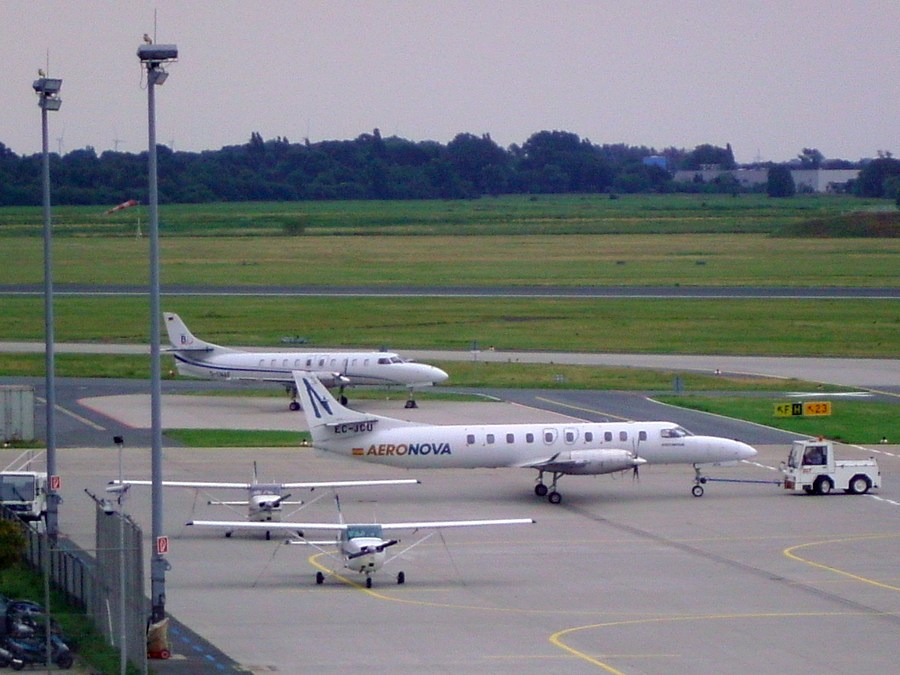
History of the Flight
The aircraft, EC-JCU, had positioned from Coventry to Lasham with two pilots and personal bags. After landing on Runway 09, the commander re-trimmed the horizontal stabiliser to the middle of the takeoff range during after-landing checks. During turnaround, the aircraft was refuelled to 4,300 lbs of fuel and loaded with 44 lbs of cargo in the forward cargo bay. The crew calculated a takeoff weight of 14,492 lbs and a centre of gravity (CG) of 264.5 inches aft of the datum, further aft than the previous flight but still within the forward portion of the CG range.
The co-pilot was the pilot flying (PF) for departure from Runway 09. After a rolling takeoff, at the rotate call of 112 kt, the co-pilot pulled back the control column but the aircraft did not respond. After several attempts, the commander took control and tried to rotate without success. He rejected the takeoff by applying reverse thrust and maximum braking. The aircraft overran the paved surface onto grass stubble. Neither pilot was injured.
Personnel Information
The commander had 2,150 total hours, with 1,915 hours on type and 250 hours as commander. The co-pilot had 585 total hours, 295 on type, and completed training in March 2006. They had flown together once before. The investigation found nothing in their training records related to handling of flying controls during takeoff.
Aircraft Information
The Fairchild SA227 AC Metro III is powered by two turboprop engines and certified for single-pilot cargo operations. The elevator is actuated via a closed-loop cable system. Pitch trim is provided by an all-moving horizontal tailplane operated by thumb switches on the control yokes. The valid takeoff range for tailplane incidence is the middle 45% of its operating range. A continuous alarm sounds if the tailplane is not within the valid range when power levers are advanced and weight is on wheels. The brakes did not have an anti-skid system.
Weight and Balance
Recalculation using actual weights (44 lbs cargo, 31 lbs manuals, 28 lbs bags) gave a takeoff weight of 14,275 lbs and CG of 262 inches aft of datum, identical to the Coventry departure. The permitted CG range at that weight was 260.4 to 277 inches aft of datum.
Aircraft Handling Characteristics
The manufacturer and another operator confirmed that with a forward CG, a large aft control column movement is required to rotate. The aircraft had subsequently performed uneventful takeoffs with normal control response.
Investigation
The investigation found no technical fault contributing to the problem. The crew's relative inexperience was considered a factor. One Safety Recommendation was made regarding the flight data recording system.