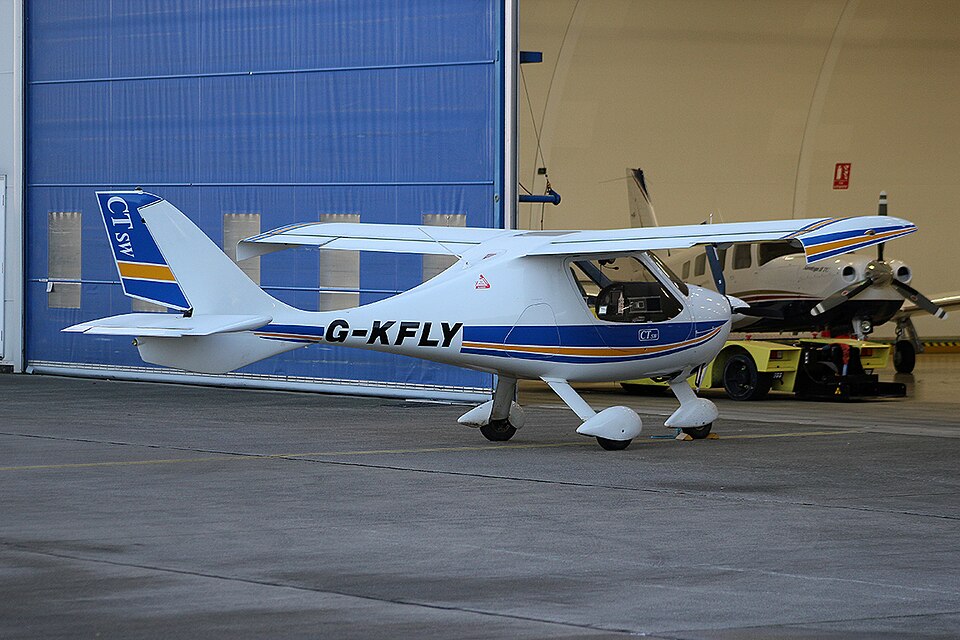
History of the Flight
The pilot, a 48-year-old National Private Pilot with 90 hours total experience (22 on type), intended to fly from Sywell Aerodrome to Abbeville, France, with a stop at Damyn's Hall Aerodrome. The weather was warm and sunny with a moderate wind from the northwest. Visibility was reducing in haze as the flight progressed south. There was a small amount of cloud at about 4,000 ft agl, and the pilot considered the weather within limits.
The outbound leg from Sywell to Damyn's Hall was uneventful. After lunch, the pilot and passenger departed for France, routing to Dover before crossing the English Channel at its narrowest point. The transit altitude was 3,500 ft in VMC, but visibility reduced to about 2 nm with no horizon; only vessels and their wakes provided a reference. The pilot realized the direction of the vessels was changing, and the aircraft was in a tight, left turn descending rapidly. He experienced disorientation and, with considerable effort, stopped the left turn and leveled the wings. He turned back and executed a gentle right turn until the cliffs came into view, providing a horizon.
Shaken by the experience, the pilot noticed his flying was “wooden” and mechanical. Instead of returning to Sywell, he decided to land back at Damyn's Hall to take stock. As he approached the airfield, he called on the radio but received no response. He joined overhead for Runway 03. The windsock indicated a crosswind from the left within his limits.
Landing Incident
On final approach, 15° of flap was selected, and the airspeed reduced to the normal approach speed of 55 kt. The approach and flare were normal, but as the aircraft was about to touch down, a gust of wind caught it, and it landed heavily and bounced. The pilot countered a roll to the right, and the aircraft veered left towards some buildings, so he executed a go-around. After climbing back to circuit height, he re-assessed and elected to divert to Southend Airport, where he made a safe landing.
Aftermath
The next day, the pilot inspected the aircraft and discovered damage to the engine frame and its mountings, and the nose landing gear attachment points. These were sustained during the heavy landing at Damyn's Hall.
Analysis
The pilot was aware that his handling of the aircraft was not as smooth and natural as usual following the disorientation experience. The wind conditions for the landing at Damyn's Hall on the return flight were not as difficult as those in which he had previously landed the aircraft safely. He considered that he had been shaken by the experience of the disorientation over the Channel, and this had affected his flying ability.