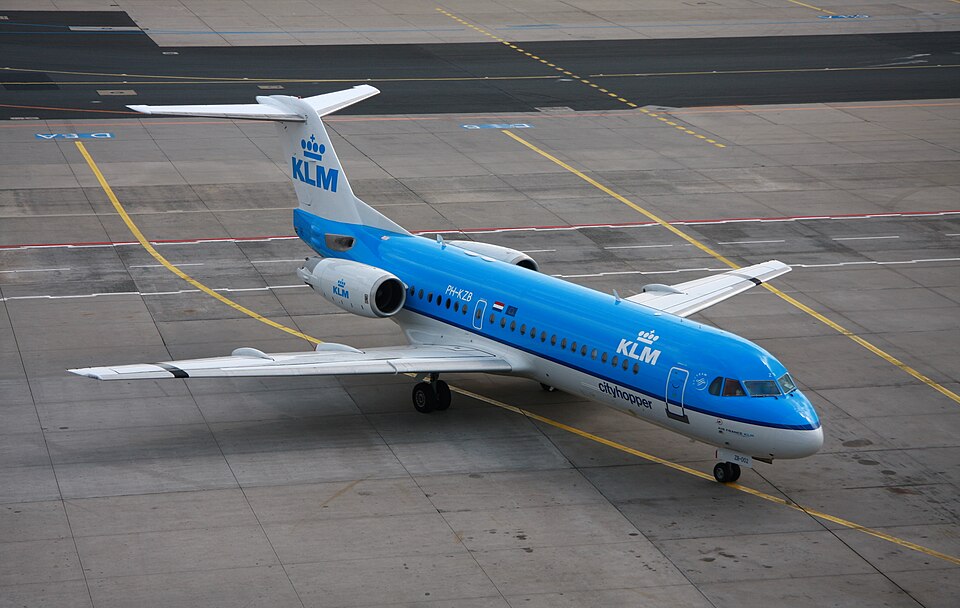
History of the Flight
The aircraft, a Fokker F.28 Mark 0070 (registration PH-KZB), had completed an uneventful flight from Amsterdam Schiphol Airport to Manchester Airport. After landing on Runway 23R, it was taxied to parking Stand 214 (centre) using the right engine, with the left engine shut down and the Auxiliary Power Unit (APU) running. Upon arrival, the parking brake was set and the right engine shut down. The cabin crew were instructed to open the airstair door at the front left side. The flight crew remained on the flight deck with the Cabin Service Supervisor (CSS) at the front left door and a second cabin attendant at the rear.
Smoke and Evacuation
Immediately after the right engine was shut down, both pilots noticed a strong smell of electrical burning and wisps of smoke. The co-pilot opened his sliding window to clear the smoke. The commander contacted the CSS via interphone, asking if there was any smoke or burning smell in the cabin. She reported none and was requested to come to the flight deck. As she opened the flight deck door, the smoke increased and she became aware of a significant presence of smoke and burning smell. The flight crew perceived the smoke coming from multiple sources, including behind the co-pilot, various vents, and behind the instrument panel.
The commander instructed the CSS to get the passengers off as quickly as possible. He then contacted ATC on the ground frequency, informing them of smoke on the flight deck and requesting the immediate attendance of the Airport Fire Service (AFS).
The CSS left the flight deck, stood on the aircraft steps, and told the Dispatcher that the aircraft had smoke in the cockpit and that passengers would be disembarking immediately. She used the cabin public address system to instruct passengers: "get off the aircraft now. Hurry, evacuate the aircraft." Initially, passengers stood up retrieving personal belongings and did not react. She then added: "evacuate the aircraft but leave your luggage behind," to which passengers responded appropriately. The rear cabin attendant saw a lady at the right side overwing exit release the door and throw it onto the wing. Passengers left the aircraft quickly via the forward left door and the right side overwing exit.
The rear cabin attendant kept passengers moving forward. As the last passengers vacated, both cabin attendants met near the overwing exit and confirmed all passengers had left. The rear cabin attendant exited through the overwing exit; the CSS, after informing the commander that all passengers were off, vacated through the airstair door.
The flight crew attempted to locate the source of the smoke but, given the imminent arrival of the AFS, shut down the APU and switched OFF electrical power. The co-pilot completed the 'Termination' checklist and exited. The commander made a final check of the cabin and toilets to confirm no persons remained, then left through the airstair door, joining passengers and crew on the parking area. All passengers were accounted for and directed into the terminal building. Two passengers were treated by the ambulance service for minor injuries sustained when moving off the aircraft wing.
Engineering Investigation
An engineering investigation identified that the emergency inverter cooling fan capacitor was completely burnt out. This had released smoke and fumes into the flight deck area.
Aircraft Operating Procedures
[The source includes a detailed abnormal checklist for on-ground emergency/evacuation, but per grounding rules, only facts explicitly stated are included. The procedure is described in the source but not summarized here as it is procedural background.]
Airport and Emergency Response
Manchester Airport has Standard Operating Procedures (SOPs) for aircraft evacuations. The incident occurred at 1705 hrs; airfield operations were immediately suspended by the Airport Duty Manager (ADM). All evacuees were accounted for and operations reinstated at 1711 hrs. An aircraft due to park adjacent was redirected.
The AFS were notified by ATC and deployed four major foam tenders, a domestic appliance, and the emergency tender, arriving within one minute. The AFS Incident Commander (I/C) found the evacuation virtually complete. Two firefighters entered the aircraft; there was a smell of burning but no visible smoke or flames, and no persons onboard. A thermal camera identified a fuse panel behind the co-pilot's seat as the source of smoke and burning smell. The commander and a maintenance engineer assisted the AFS by ensuring the aircraft was safe with electrical system OFF.
The AFS I/C liaised with the ADM to secure the site. Several ground personnel attempted to access the aircraft to remove baggage. At 1845 hrs, it was agreed the fire risk was minimal, and the scene was handed over to police.
The AFS I/C noted excellent communication between himself and the ADM. He also expressed concern about non-essential personnel trying to gain access to the aircraft.
Other Observations
The source notes a previous similar event on a Fokker 70 where the emergency inverter was suspected. In that case, no evidence of burning was immediately obvious around the inverter or its wiring, but when the unit was removed, a strong electrical burning smell was present around the exit.
Probable Cause
The emergency inverter cooling fan capacitor burnt out, releasing smoke and fumes.