History of the Flight
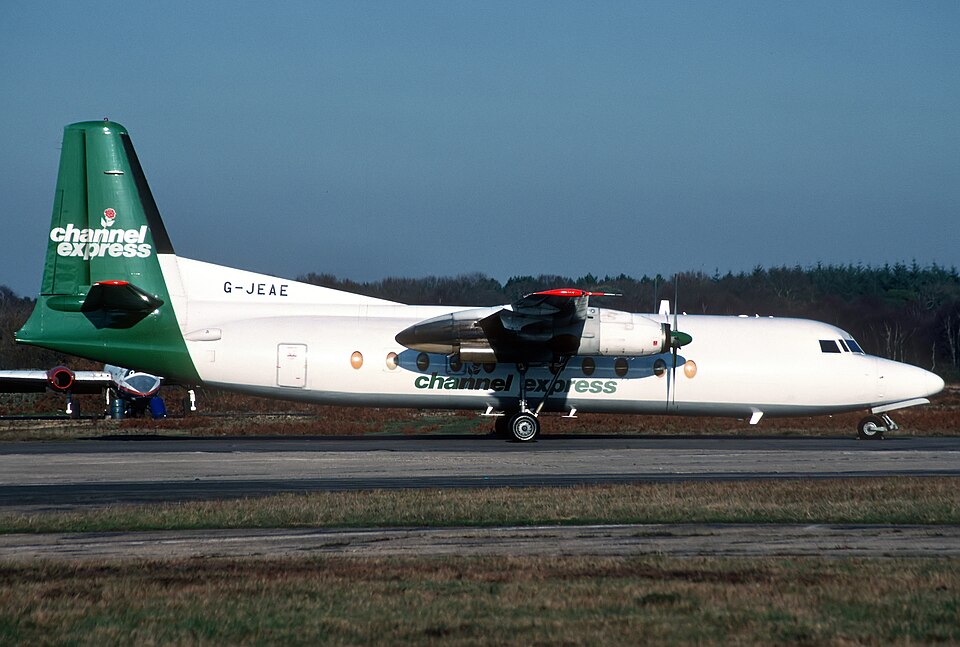
The aircraft, a Fokker F27 Mark 500 Friendship registered G-JEAE, operated a cargo flight from Bournemouth to Guernsey on 20 June 2002. The pre-flight inspection revealed no external damage. Departing Bournemouth at 0442 hrs, the flight proceeded uneventfully in good weather. The crew became visual with Guernsey from some distance.
At 0451 hrs, the Automatic Terminal Information Service reported wind from 320° at 3 kt, visibility 28 km with fog patches, few clouds at 1,500 feet, temperature +11°C, dew point +10°C, and QNH 1021 mb. The crew later reported surface wind from 270° at 3 kt, 28 km visibility, and no cloud. At 15 nm from the aerodrome, after advising ATC they were visual, they were cleared to self-position for a visual approach to Runway 27.
Approach target speed was 120 kt, with Vref for landing of 100 kt. The commander stated the aircraft was stabilised at about 2 nm at Vref plus 5 kt with 40° flap. The first officer recalled the aircraft steady at Vref plus 10 kt by approximately 800 feet QNH (464 feet aal) and later advised the commander that speed was Vref plus 5 kt, reminding him the aircraft was "fairly heavy." Both agreed speed was Vref or greater crossing the threshold.
The aircraft was not allowed to float during flare to minimise landing distance. The crew did not consider the pitch attitude excessively nose high or the landing heavy, but the co-pilot noted a fairly short landing roll. The duty aerodrome controller observed an unusually nose high attitude during landing, which appeared heavier than normal. Touchdown occurred at 0515 hrs.
After landing, the aircraft taxied to the apron and shut down. During the next pre-flight inspection, the commander discovered a tailstrike, which came as a surprise as he considered it extremely unlikely with flap 40° and Vref maintained beyond the threshold. Witness marks indicated the aircraft landed 120 metres from the threshold on a level portion of the runway.
Damage to Aircraft
The tailskid was pushed 2.5 inches into the aircraft skin. Repairs required replacement of the skid and minor repairs to the surrounding skin and back-up structure. The rear pressure bulkhead was undamaged.
Aircraft Information
The loadsheet showed a landing weight of 18,715 kg with a mid-range centre of gravity. Maximum landing weight was 19,051 kg.
Flight Recorder Data
The flight data recorder (FDR) provided a 25-hour time history of altitude, airspeed, heading, normal acceleration, and flap position. Attitude and engine power were not recorded, nor required. Misalignment of the flap position transducer made flap position not directly determinable, but using previous flights, the outputs for each flap position were established. On the accident flight, flaps moved from 0° to 40° in 22 seconds; 95 seconds later the aircraft landed.
The aircraft was established on final approach at about 2.5 miles, level at 1,000 feet aal. Seventy-five seconds before touchdown, it began descending. Rate of descent increased to about 2,300 ft/min, then reduced and stabilised at 560 ft/min by 500 feet aal. In the last three seconds, sink rate increased then decreased just before wheel contact. At 500 feet aal, speed was 114 kt (Vref plus 14 kt), decreasing to 95.5 kt (Vref minus 4.5 kt) at 50 feet aal, then to 91 kt (Vref minus 9 kt) at touchdown. A normal acceleration of 1.9 g was recorded.
Additional Information
The manufacturer advised that normal pitch attitude during landing is 2° to 3° nose up. With oleos compressed, a pitch attitude of 7.1° or more is required for tailskid contact on level ground; with oleos extended, 9.3° or greater is needed.
The operator's Operations Manual specified for visual approach: at about 300 ft with landing assured, select flaps 40° and adjust power to maintain approach speed (120 kt for flap 40°). During flare, smoothly retard power levers to idle and flare to a slightly nose up attitude, letting main wheels touch. The Quick Reference Handbook (QRH) gave approach speed as Vthr plus 10 kt; for a landing weight above 18,100 kg with flap 40°, Vref was 100 kt. With light winds, Vthr was 101 kt, making approach speed 111 kt. This conflicted with the Operations Manual's 120 kt.
Both pilots believed touchdown speed was at or above Vref, but FDR data showed it was below. The increased sink rate in the final three seconds was probably due to power reduction and loss of slipstream lift. Reducing the sink rate at a speed significantly below Vref would have required a greater flare. The aircraft landed firmly with a pitch attitude of 7.1° or more.
Probable Cause
No probable cause was explicitly stated in the source. The operator subsequently amended standard operating procedures to remove inconsistencies regarding visual approaches and flap 40° landings.