History of Flight
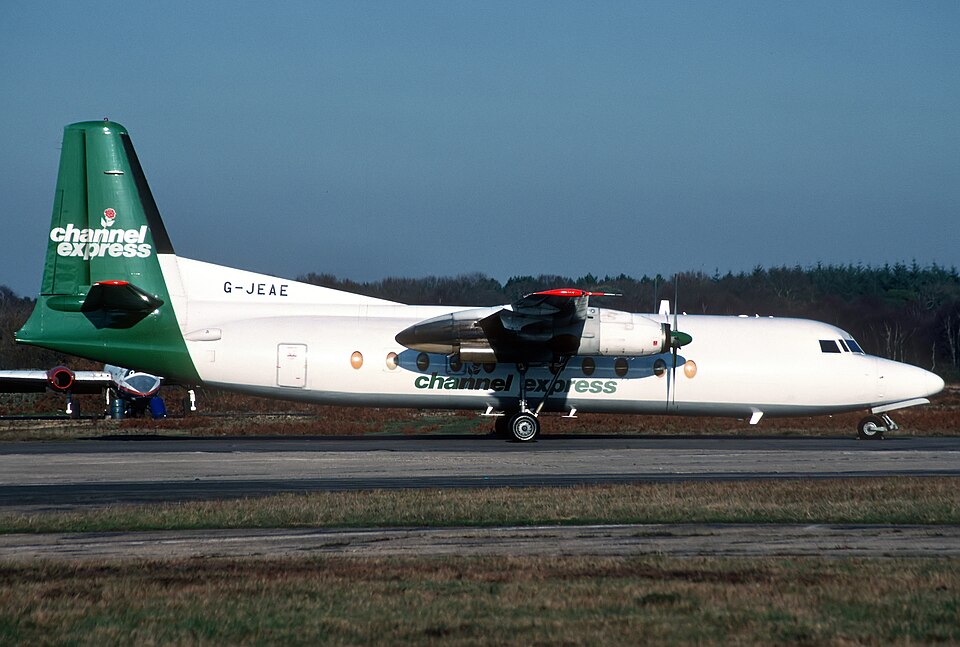
The aircraft, a Fokker F27 Mark 500 registered G-JEAE, was conducting a scheduled public transport flight from Isle of Man (Ronaldsway) Airport to Bristol Airport. The first officer, under initial line training, was the handling pilot. The approach to Runway 27 was uneventful, with an ILS approach in dry conditions. Surface wind was 200°/14 kt, visibility 6,000 metres, and cloud base at 700 feet. The landing weight was 16,876 kg, well below the maximum of 19,051 kg, giving a threshold speed of 95 kt. The crosswind component was 13 kt from the left, within the 30 kt maximum demonstrated.
Touchdown was normal on the centreline at about 95 kt. As the aircraft slowed, the commander reminded the first officer to use full rudder for directional control. He noticed the aileron had returned to neutral and called "My tops," reapplying into-wind aileron. At about 60 kt, the aircraft moved slightly right then swung violently left. The commander applied right rudder, but the first officer had already applied full right rudder. Using the tiller, the commander steered right, but could not prevent the aircraft from departing the paved surface to the left. It continued turning right and came to rest with the left main gear on grass and the right main and nose gears on the paved surface. No emergency evacuation was ordered; occupants left via steps.
Crew Experience
The commander held an Airline Transport Pilot's Licence, aged 31, with 3,240 hours total, 1,200 on type. The first officer had 794 hours total, only 19 on type, and was in the final stage of F27 training. He had no significant training issues.
Flight Data Recorders
The aircraft carried a Fairchild CVR and a Sundstrand Universal FDR. The FDR recorded seven parameters: pressure altitude, airspeed, magnetic heading, flap position, normal acceleration, and RT transmission discretes. No braking data were recorded. The data showed normal approach and landing, with slight heading oscillations (±2°) during the landing run. At about 60 KIAS, heading diverged from 265° to 272° right, then left to 241°, a 31° change in 4 seconds. The aircraft then turned right again to rest at 303°.
Engineering Aspects
Runway examination the next morning revealed wheel tracks equally disposed about the centreline. Marks ran straight for 150 metres, then slight right movement followed by an abrupt left swing 180 metres from start, with a 30° heading change. The aircraft was turning right before leaving the runway and continued that correction, bringing the nose and right main gear back onto the surface. Heavy marks from right main tyres indicated loading during the swerve; the No 2 left tyre showed periodic brake application with anti-skid pulsing.
Aircraft examination found no faults in landing gear, brakes, wheels, or nosewheel steering. A fast taxi run to 70 kt in similar conditions showed normal handling. Several components were replaced as a precaution, but no discrepancy could account for the excursion.
Analysis
No significant braking system malfunction was found, but tyre marks indicated the left brakes had been applied gradually until the Maxaret anti-skid system released the outer wheel. The marks were consistent with crew reports and FDR data. It is possible that the first officer, who is taller than average, inadvertently pressed the left brake pedal as the rudder pedal travelled backwards while applying right rudder. Initial brake application may have been small, requiring increased right rudder to counter it, progressing to full right rudder with large left brake application. The heading change rate of about 8°/second made it unreasonable for the commander to intervene sooner.