History of the Flight
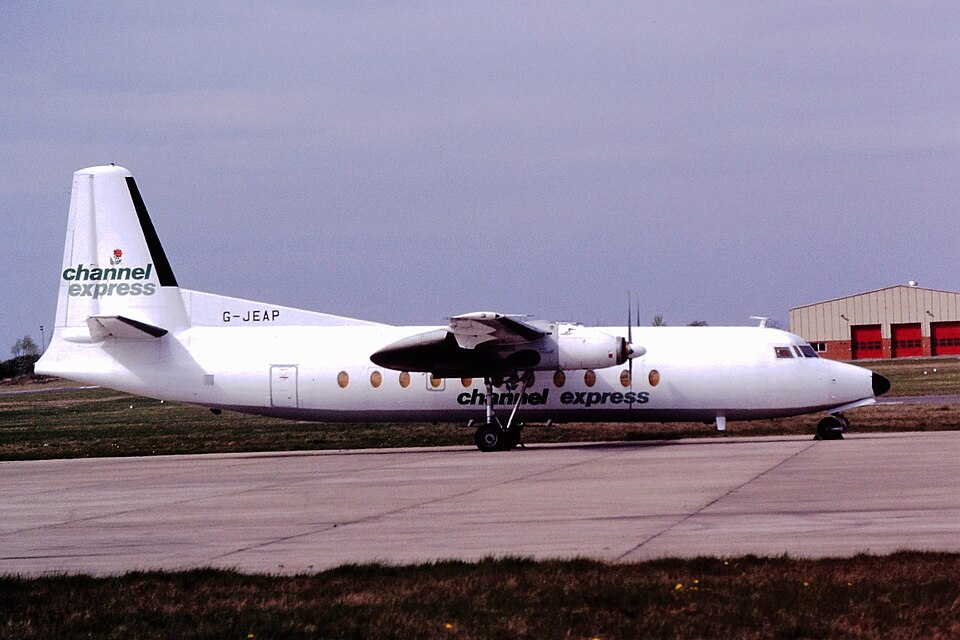
The aircraft and crew were scheduled for an overnight turnaround flight from Coventry to Belfast carrying parcel freight. The flight to Belfast was uneventful. For the return flight, the aircraft uplifted 400 kg of ballast and 1,900 litres of fuel. The commander was the handling pilot. The weather at Coventry included surface wind 120°/5 kt, visibility 1,800 metres in mist and light rain, cloud broken at 400 feet, temperature 13°C, dewpoint 12°C, QNH 1009 mb, and a wet runway. A surveillance radar approach (SRA) to Runway 05 was initially in use, but the approach was changed to an ILS on Runway 23 with a Decision Altitude of 465 feet (200 ft agl).
The aircraft intercepted the localizer at about 6 miles from touchdown. The commander deselected the autopilot and flight director and flew manually. The landing gear was lowered before glideslope interception, and landing flap was set to 26.5°. Target approach speed was 105 kt with Vref of 95 kt. The aircraft settled slightly high on the glidepath with airspeed at 120 kt. At about 300 ft agl the commander saw approach lights and intended to land. At 200 ft agl, the aircraft was still above the glidepath. The First Officer called 'four whites' indicating the aircraft was high on the 3° approach path. The commander reduced power to decrease speed and minimised the flare. Touchdown occurred in a flat attitude at 114 kt (Vref plus 19 kt), approximately 600 metres along the runway with 1,000 metres remaining. An eyewitness in the control tower reported touchdown considerably further down the runway, initially on the nosewheel.
After touchdown, the commander selected ground fine pitch (GFP) on both engines and kept his hands on the power levers. Neither crew member heard the normal aerodynamic braking noise. The First Officer looked for the GFP lights but could not immediately discern them due to light conditions. He began but did not complete his standard call. Both pilots recalled a lack of retardation initially but were aware of brakes operating. The commander applied maximum braking when he realised stopping would be difficult, but retardation remained low.
At a groundspeed of approximately 60 kt, the aircraft left the paved surface just left of the centreline, heading towards the ILS localizer aerial. To avoid the aerial, the commander steered right. The nosewheel impacted a slight ridge from a concrete plinth of a small ILS monitor aerial, collapsing the nose landing gear backwards. The aircraft skidded on its mainwheels and nose gear doors, impacting the airfield perimeter fence and coming to a halt with the nose protruding across a minor road. The crew shut down engines, operated fire extinguishers, and evacuated through the crew exit, which was difficult to open due to the fence.
Aircraft Damage
Examination revealed the nose leg collapsed, causing extensive damage to the nose cone. Both propellers were damaged, the right more severely, likely from contact with the fence and possibly the left propeller striking a glide slope monitor aerial. Both propellers were turning at final impact. The right engine mount suffered structural failure and internal drive failure. Wrinkling occurred on the right nacelle adjacent to the landing gear pick-up point, and lighter damage on the left nacelle. Signs of oleo collapse on the right gear leg were consistent with hard landing inspection features. Wrinkling at the wing/fuselage fairing suggested possible loss of alignment. Both right tyres had extensive flat spots, with the outer tyre worn through to create a hole.
Meteorological Information
The synoptic situation at 0500 hrs on 1 July 2000 showed a complex frontal system over Southern England with a moist south-southeasterly airstream. Visibility was about 1,500 metres in rain and drizzle, cloudbase about 600 feet. Surface wind at Coventry was 110° at 6 kt, veering to 150° at 12 kt between 500 ft and 2,000 ft agl. Actual rainfall was not recorded, but radar images indicated maximum rainfall rate of 1 mm per hour for the five hours prior. The runway was classified as 'wet' over its full length, but there was no standing water; controllers felt it was closer to 'damp'.
Additional Information
The aircraft's load on departure included 2,840 kg of fuel, 180 kg of water methanol, and 400 kg of ballast. The centre of gravity for takeoff and landing was well within limits but toward the forward end. Runway 23 at Coventry is 1,825 metres long with a displaced threshold giving landing distance available of 1,615 metres. The runway is asphalt and level. Runway friction classification survey on 15 June 2000 reported the centre portion had slight friction.