Introduction
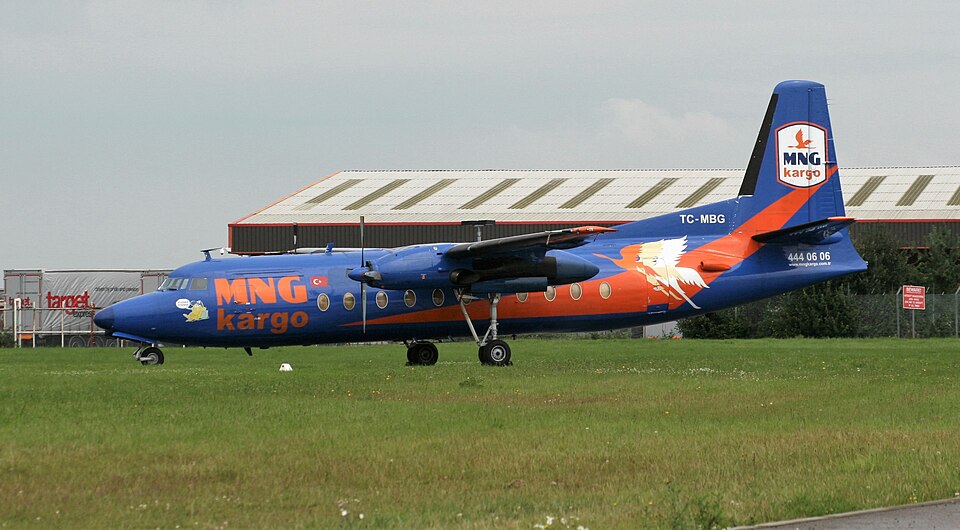
On 1 February 2008, a Fokker F27 Mk 500 Friendship, registration TC-MBG, experienced a ground incident at Stand 201, Edinburgh Airport. The aircraft was preparing for a night cargo flight to Coventry. The weather was wintry with snowfall, necessitating de-icing. The aircraft had been repositioned to face out of the stand, down a slight slope, due to forecast high winds.
History of the Flight
The crew reported for duty at 1900 hrs for a scheduled departure at 2050 hrs. A ground power unit (GPU) was connected to the right side of the aircraft. Two ground handlers were present: a marshaller and an assistant. After de-icing, the company engineer inspected the aircraft and collected the de-icing certificate. At approximately 2113 hrs, the co-pilot requested and received start clearance from ATC. The co-pilot then began the ‘Before Start’ checklist. When he called “Parking brake”, the commander did not respond, as the company engineer returned and verbally confirmed that the nosewheel was chocked.
Events Leading to the Accident
The commander signalled the marshaller to start engines. After both engines stabilised, the commander noticed that the main and brake pneumatic system pressures had fallen to 1,600 psi. He advanced the power levers to restore pressure to 1,800 psi. He then signalled the marshaller to disconnect the GPU. As the marshaller went to assist his colleague in removing the GPU, the aircraft began moving forward slowly. The marshaller shouted a warning, and both handlers ran clear. The flight crew were unaware of the movement until they heard a loud bang from the right side. The commander shut down both engines and secured the aircraft. Upon exiting, he observed no chocks near the nosewheel.
Aftermath
The Airport Fire and Rescue Services arrived within two minutes. They placed chocks on the nosewheel and applied foam under the right engine to cover leaking fuel. Examination of the accident site the next morning revealed no chocks at any wheels initially; two chocks were later found in the wreckage of the GPU. The GPU power lead was trailing on the ground, and the ground power receptacle door was closed. The handling agent had modified its GPUs to prevent towing while connected.
Investigation Findings
The Air Accidents Investigation Branch (AAIB) conducted the investigation. The Cockpit Voice Recorder captured the event, showing that the commander had increased engine speeds to about 8,600 rpm to charge the system. The propeller strike lasted 0.7 seconds, followed by a gap, then another second of strike noise, and a louder mechanical sound possibly from the engine breaking free. The Flight Data Recorder had not started recording. No cause could be positively identified for why the aircraft moved. The investigation noted that Edinburgh Airport’s Managing Director’s Directive 04/07 prohibited straight pushbacks from North Cargo Apron stands and required aircraft facing out to be pulled off the stand before engine start. The commander stated he had not received this directive until 24 days after the accident.