History of the Flight
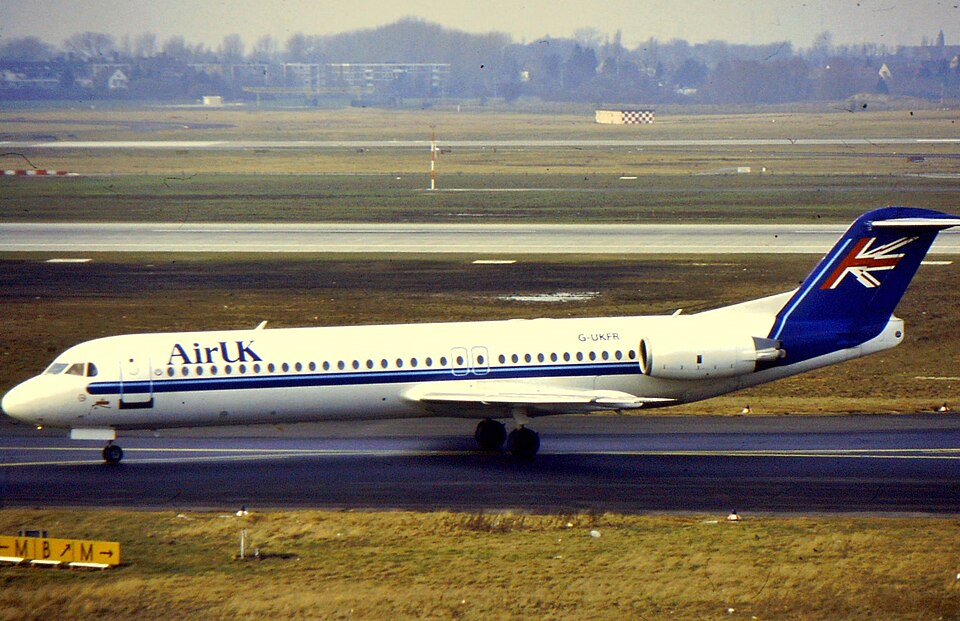
On 1 May 1999, a Fokker F28 Mark 100, registration G-UKFR, was operating a public transport flight from Amsterdam to Aberdeen. Approximately 40 minutes after takeoff, the first officer asked the commander if he could smell burning. The commander initially did not detect the odor but called the cabin supervisor to the flight deck. As she entered, a strong smell of electrical burning became apparent. The commander instructed her to close the flight deck door and use the interphone for further communication.
Around the same time, the crew observed that the right primary flight display (PFD) had begun to fluctuate and change to a non-standard format. As a precaution, the commander directed the first officer to switch off his PFD, navigation display (ND), and flight management computer (FMC). The pilots donned their oxygen masks and turned off the re-circulation fans.
Crew Actions and Diversion
The commander, who had been the non-handling pilot, transmitted a PAN call requesting a diversion to Humberside with an immediate descent, then took control of the aircraft. Over the next 5 to 10 minutes, several level 2 alerts related to FMC navigation occurred, all map information was lost on the remaining ND, and the flight director failed. The aircraft was set up for a raw data surveillance radar approach as a precaution against total navigation failure. A high-speed short pattern SRA was conducted, during which the runway was acquired visually, and the aircraft made an uneventful landing.
Landing and Aftermath
As there had been no further signs of fire, the commander decided before landing that an emergency evacuation was not necessary. After the aircraft came to a halt in a suitable position, all power was switched off, and passengers disembarked through the normal exit. Emergency services were in position upon arrival and monitored the situation.
Examination Findings
Maintenance personnel from the operator examined the aircraft and replaced the right PFD. After replacement, the system functioned correctly. No smell of burning was apparent after the system had been powered up for 30 minutes, and the aircraft was cleared for service. The suspect PFD was returned to the manufacturer for examination and repair. A burnt-out Random Access Memory (RAM) electronic chip was discovered. After modification of the PFD in accordance with several applicable Service Bulletins, the unit was aligned, tested, and passed as serviceable. No reason was determined for the failure of the RAM chip.