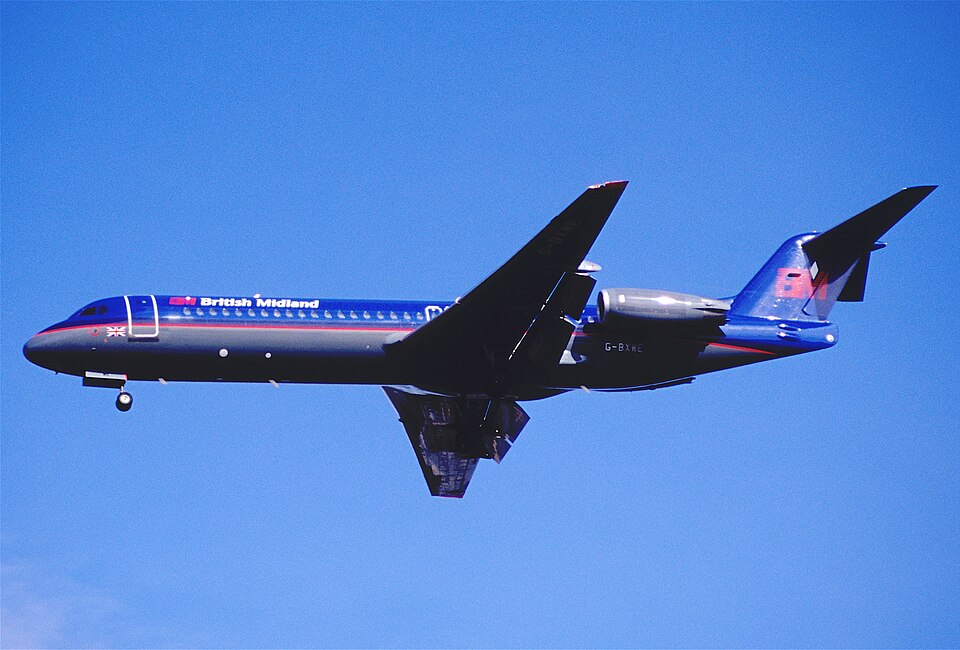
History of the Flight
On 29 October 2003, a Fokker F28 Mark 0100, registration G-BXWE, operated a public transport passenger flight from London Heathrow. Before departure, the crew was informed that the No 2 air conditioning pack was inoperative. The aircraft is permitted to fly with one pack inoperative, subject to a maximum altitude restriction of 25,000 feet (Flight Level 250). The flight plan was amended accordingly, and the aircraft departed at 0811 hrs UTC.
Upon reaching FL250 over the English Channel, the flight crew detected a hot smell from the air conditioning vents. The pack duct temperature indicated 94°C, compared to a normal reading of 17°C. Seconds later, the cabin altitude began to rise at a rate exceeding the maximum indicated 2,500 ft/min; the commander estimated the rate between 4,000 and 6,000 ft/min. With insufficient time to troubleshoot, the commander set the pressurisation control to manual, but this had no effect. When the cabin altitude reached 10,000 feet, the crew donned oxygen masks and initiated an emergency descent. During the descent, the cabin altitude peaked at 15,500 feet, triggering automatic deployment of passenger oxygen masks. Masks in Row 2 seats D, E, and F became entangled and unusable, but the single passenger in that seat group used a mask from an empty seat behind. The aircraft levelled off at 10,000 feet and returned to Heathrow.
Description of Air Conditioning System
The aircraft is equipped with two identical air conditioning systems, packs 1 and 2. Each pack can independently supply air conditioning and pressurisation. Bleed air from the engines provides airflow to both packs. Hot bleed air enters the packs and is directed to the temperature control valve (TCV) and the cooling system. The cooling system converts hot bleed air into cold air. The TCV regulates the mixture of hot and cold air and can be controlled automatically or manually.
Maintenance History
Between mid-September and early November 2003, the aircraft experienced repeated defects in both packs, including noisy packs, hot smells, lack of flight deck temperature control, surging and hunting, erratic pressurisation during descent, and rapid duct temperature rises. Components replaced during troubleshooting included coalescer bags, flow control valve, air cycle machine, ducts, and TCVs.
On 26 October 2003, three days before the incident, the crew shut down both packs after a double pack 1 fault and pack 2 fault alert. The aircraft returned unpressurised to Heathrow. Investigation revealed a leaking sense line on the pack 1 TCV, which was replaced. The pack 2 TCV was also replaced due to being suspect. During replacement, the pins in the airframe half of the electrical connector were found in poor condition, and a Carried Forward Defect (CFD) was raised for future replacement. The CFD wording was ambiguous, referencing the Minimum Equipment List (MEL), which permits operation with one pack inoperative. This led to the aircraft being dispatched with pack 2 inoperative on 29 October.
During the incident flight, pack 1 failed. The pack 2 connector defect was later rectified, and the pack tested satisfactorily. Troubleshooting of the pack 1 failure revealed the flight deck temperature sensor ducting was adrift from its mounts. The duct was replaced, and the system tested correctly on the ground. After return to service with both packs operational, further pack 1 defects occurred. Additional components were replaced, including relay K1816A and the flight deck air conditioning control panel. Following consultation with the manufacturer, wiring checks found the flight deck temperature sensor operating out of limits. The sensor was replaced, and no further problems were reported.
Discussion
The operator's engineering staff conducted troubleshooting over an extended period using Aircraft Maintenance Manual procedures. The original pack 1 pressurisation problem was probably caused by the faulty temperature sensor. After the incident, the operator investigated the ambiguous CFD entry that led to dispatching the aircraft with pack 2 inoperative. Personnel involved were instructed not to refer to the MEL in a CFD entry unless the aircraft was to be operated in accordance with the MEL.