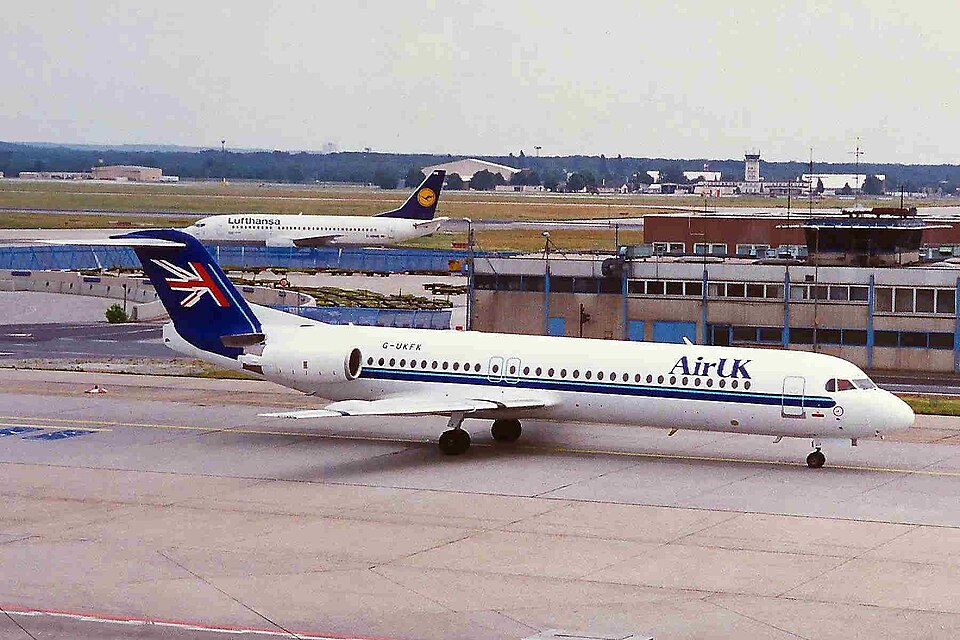
Incident Summary
On 24 September 1998 at 1000 UTC, a Fokker F28 Mk 100, registration G-UKFK, operated a scheduled public transport flight from Amsterdam Schiphol Airport to Belfast. The aircraft, manufactured in 1988, was equipped with two Rolls-Royce Tay 620-15 turbofan engines. On board were six crew members and 62 passengers; no injuries were reported. The takeoff from Runway 01L was normal, but a pilot in another aircraft reported that a wheel had separated from G-UKFK as it left the ground.
Flight Crew Actions
The flight crew performed a fly-by over Runway 01R for a landing gear inspection. Ground personnel confirmed that the left-hand outboard mainwheel was missing, the brake pack remained in place, and no further damage was apparent. The separated wheel and tyre were recovered shortly afterward. The crew decided to return to Schiphol. Uncertain of the landing gear condition, they prepared for an emergency landing using the Emergency Checklist for 'gear unsafe', briefed cabin crew and passengers, and spent approximately one hour burning off fuel to reduce landing weight. The landing was normal, with touchdown on the right main landing gear. Full reverse thrust was applied, and the left wing was held up with aileron until about 80 knots, after which the aircraft came to a normal halt.
Technical Examination
The incident closely resembled a previous occurrence involving another aircraft of the same operator at Aberdeen in February 1998. In both cases, the mainwheel separated because of the absence of a circular spacer normally installed between the wheel nut and the wheel assembly. In both instances, the spacer had not been reinstalled during a wheel change. For G-UKFK, a wheel change had been performed at Newcastle Airport by a third-party maintenance organisation the previous evening (23 September 1998). The missing spacer was later found at Newcastle, still adhering to the removed wheel.
Following the earlier incident, the operator's maintenance organisation had issued an internal Engineering Bulletin outlining the correct wheel-change procedure. They had also identified that the manufacturer had produced a modification, promulgated in Service Bulletin SB F100-32096, which integrates the wheel nut and spacer into a single unit, preventing application of the nut without the spacer. As an interim measure, the maintenance organisation generated stick-on tape marked 'SPACER?' to serve as a reminder for maintenance engineers.
Conclusion
The left-hand outboard mainwheel separated due to the absence of the circular spacer between the wheel nut and wheel assembly, which was not reinstalled during a wheel change.