Background
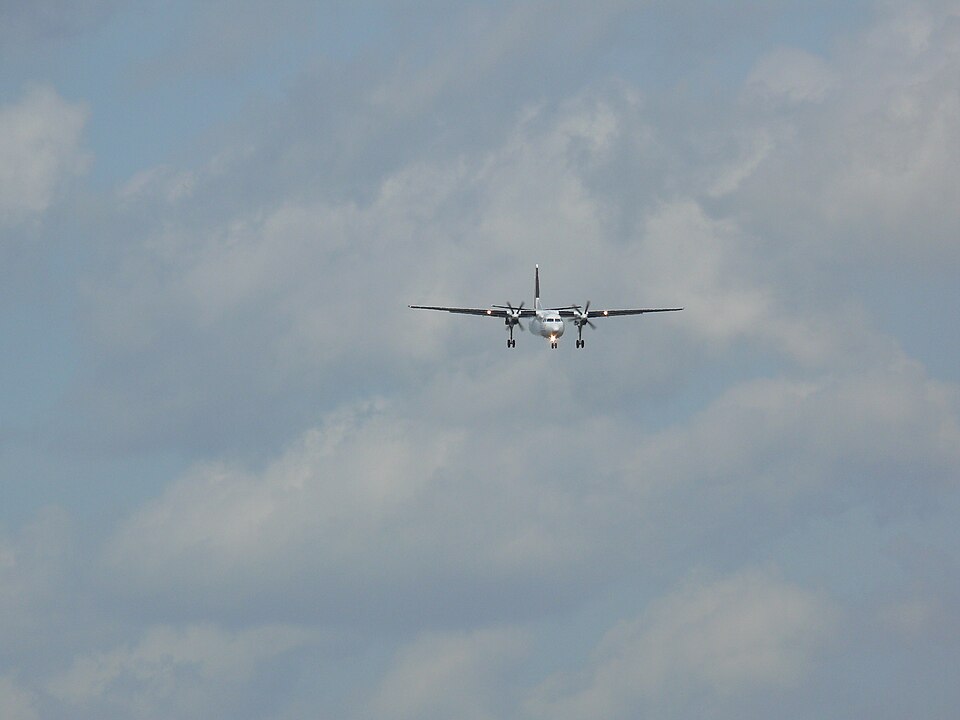
On 15 January 2009, a Fokker F50 (registration OO-VLF) operated a commercial passenger flight from London City Airport to Ronaldsway Airport, Isle of Man. The aircraft was manufactured in 1991 and powered by two Pratt and Whitney Canada PW 125B turboprop engines. The commander, aged 37, held an Airline Transport Pilot's Licence and had 6,500 total flying hours, with 4,950 on type. The approach was flown manually after the commander disconnected the autopilot.
Flight Events
The aircraft was cleared to land on Runway 26 at 1005 UTC. The surface wind reported by ATC was 180° at 24 kt. The commander briefed for a radar vectored ILS approach, noting the wet runway and crosswind conditions. During the approach, the aircraft maintained a crab angle of 20° (heading 245° versus runway 265°). At approximately 50 ft above ground level, the commander initiated decrab using right rudder and left aileron. The aircraft touched down on a heading of 253°, bounced, and upon second touchdown the commander applied and held full right rudder. The aircraft began tracking left. The commander recalled selecting ground idle and applying wheel brakes, but shortly after the aircraft departed the left side of the paved surface. The aircraft came to a stop with the nose and left main landing gear off the pavement. The commander attempted to taxi back, but the left main gear would not move, causing further left movement. The Airfield Fire and Rescue Service advised shutting down the engines, which the commander did. Passengers deplaned via the rear right exit. Several passengers noted difficulty jumping from the door sill height.
Weather Conditions
The 0950 METAR reported surface wind 180°/26 kt, 8 km visibility, few clouds at 700 ft. At landing, the airport AWOS showed a two-minute average wind of 170°/25 kt with maximum gust in prior ten minutes of 34 kt. The maximum gust ten minutes after the incident was 37 kt.
Recorded Data
Flight Data Recorder and Cockpit Voice Recorder data showed the approach was stable. Touchdown occurred at 91 kt indicated airspeed. Windshear check 35 seconds before touchdown indicated 180°, 24 kt. After touchdown, full right rudder and control wheel inputs into wind were applied. Just over two seconds after touchdown, engine torque and propeller rpm increased, indicating reverse engagement. The aircraft manufacturer confirmed these values corresponded to maximum reverse power. Five seconds after touchdown, the commander handed control column to the co-pilot. Control wheel moved from left to right roll, then back to left; rudder remained at full right deflection. Fifteen seconds after touchdown, the aircraft left the paved surface, indicated by increased normal acceleration and left roll. The aircraft stopped on heading 258°M. After stopping, an attempt to taxi resulted in further left swing to 230°M. Engines were shut down approximately four minutes after stop.
Aircraft and Runway Examination
No defects were found with braking, anti-skid, nosewheel steering, or rudder. Electronic Engine Controls showed no disparities. Runway 26, recently resurfaced and grooved, had a friction coefficient of 0.9 on 26 December, verified the day after the incident. No heavy braking or anti-skid operation signs were present.
Operational Procedures
The operator's Operations Manual stated: "The rudder is not effective for directional control with reverse." The manufacturer's Aircraft Operating Manual recommended maximum crosswind component of 33 kt for runways with good braking action. The AOM landing technique advised selecting ground idle after nosewheel touchdown and using reverse when required, noting rudder ineffectiveness with reverse. The manufacturer explained that high reverse power disrupts rudder airflow, reducing effectiveness, and that aileron in crosswind prevents upwind wing lift, but reverse power can negate this.
Commander's Actions
The commander stated he intended to select ground idle and only apply reverse just before leaving the paved surface. However, data showed maximum reverse was selected just over two seconds after touchdown. The commander noted this was not his intended action and that airflow effects of reverse may have caused directional control issues.