History of the Flight
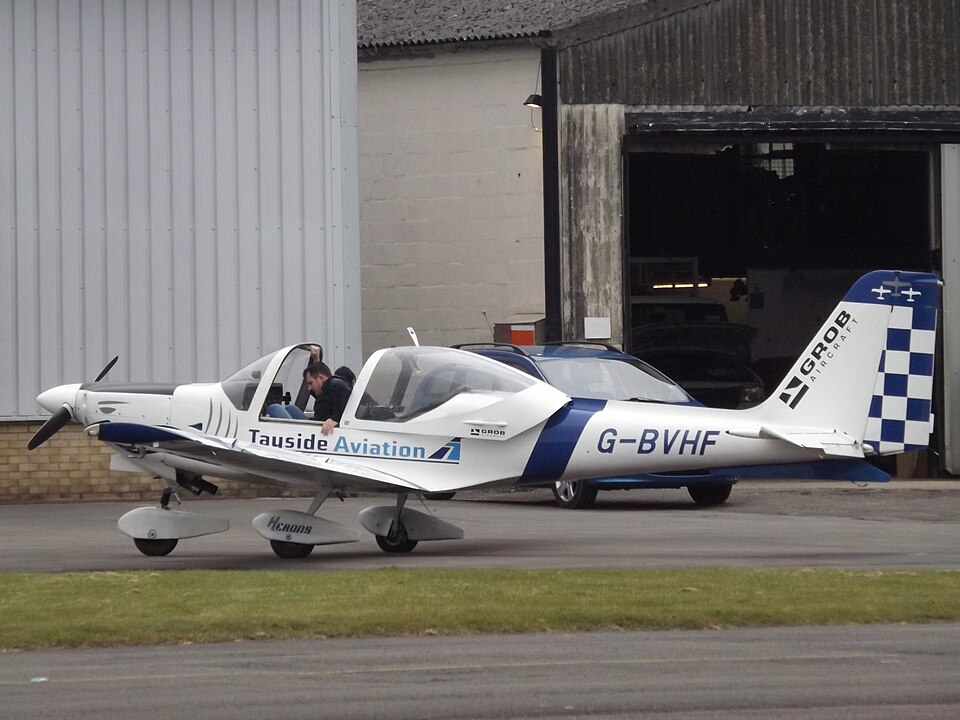
The aircraft, a Grob G115 D2 (registration G-BVHF), was conducting initial flight instruction as part of the Air Cadet Pilot Scheme. It was the student's second flight with full control in the circuit and landing. The flight operated from Runway 28 at Dundee Airport in fine weather with good visibility and a reported wind of 300° at 3 kt.
The first circuit was flown satisfactorily. During the second circuit, the early part of the final approach was slightly high. The student corrected by reducing power and lowering the nose, maintaining a constant 65 kt. Permission for a touch-and-go was received from ATC in good time.
Instructor's Account
As the aircraft approached the runway threshold, the student began aligning with the runway and smoothly reducing power. The instructor, who was 'following through' the student's control inputs, noticed no reason to intervene. Suddenly, the aircraft rolled left. The instructor took control, stating "I have control". The student acknowledged but momentarily resisted the instructor's application of full power.
The instructor applied control to stop the leftward movement, raised the nose slightly above the horizon, and retracted the flaps from 60° to the 'Takeoff' setting. However, the aircraft did not respond to control inputs. The instructor performed a forced landing on the grass to the left of the runway. The aircraft touched down about 10 m from the boundary fence after the left wingtip initially contacted the ground. It struck the fence at approximately 45°, then slid to the right. The nose landing gear collapsed, and the nose and right wing were severely damaged. No fire occurred, and both occupants left the aircraft without assistance.
Student's Account
The student's written statement was consistent with the instructor's recollection. The student reported control difficulties beginning at about 100 ft, worsening near the ground. With full power applied and flaps set to takeoff, the aircraft did not respond to inputs, and the left side seemed to drop.
Aircraft Examination
Post-accident examination revealed no mechanical deficiencies that would have preceded the event. The stall warning system, operating from a vane on the left wing, was functional. There was no evidence of disruption or restriction in the flight control system. The electrically actuated flaps indicated they were travelling to the 'Takeoff' position as selected.
Witness Observations
An ATC witness in the control tower, about 170 m to the right of Runway 28 and nearly abeam the touchdown area, reported that the aircraft appeared to stall at about 50 ft during the go-around, with the left wing dropping followed by the nose. Before the aircraft struck the ground south of the runway, the nose had been raised so initial impacts were on the left wingtip and left main landing gear.
Post-Accident Analysis
The flying school, which had recently acquired four Grob G115 D2 aircraft, attempted to replicate the accident conditions at altitude but without success. Further testing by another instructor indicated that the conditions could be replicated if go-around power was applied without sufficient right rudder, resulting in a left wing drop exacerbated by right aileron input rather than using right rudder to 'pick up' the wing. The chief flying instructor noted that the instructor appeared slow in taking control and that a slight delay when the student momentarily resisted full power may have been contributory.
The instructor later commented that he did not believe the aircraft had stalled and that he had not used significant aileron during the go-around. He considered that a lack of aircraft performance was a major factor in the event.