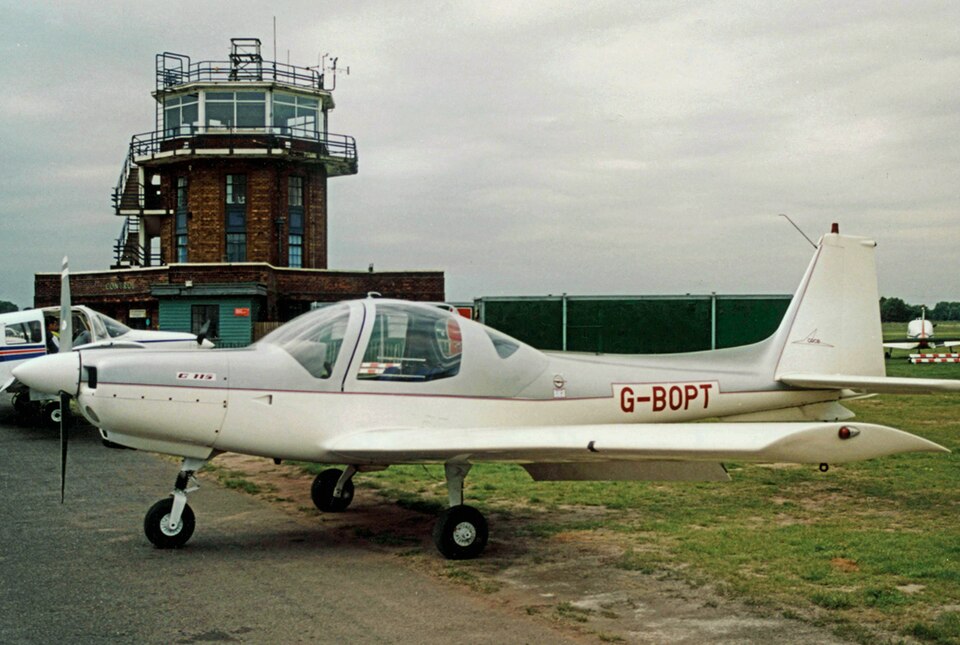
History of the Flight
The aircraft, a Grob G115 with a single Lycoming O-235-H2C piston engine, was conducting a training flight with an instructor and a student on board. Following an uneventful demonstration of a precautionary circuit and full stop landing, the student took control to repeat the exercise. The student executed a normal circuit and stable approach. During the landing roll, as the aircraft decelerated, it began to veer to the right. The instructor suspected a steering problem and applied left rudder, causing the aircraft to regain runway heading. Shortly thereafter, the aircraft again veered to the right and came to rest at right angles to the runway.
Upon exiting the aircraft, it was evident that the complete right wheel assembly had separated from the aircraft. The right main landing gear stub axle had broken. The instructor reported that a similar occurrence had taken place on 17 June 2008, involving the left landing gear; that event was not reported to the AAIB.
Axle Examination
The fractured stub axle was sent to the AAIB for detailed metallurgical examination. The axle had fractured as a result of fatigue cracking at a location a short distance outboard of its attachment to the landing gear strut. This location was close to a change in cross-section that formed a shoulder for the inner wheel bearing. The fracture plane was normal to the axle axis, slightly outboard from the corner of the reduced diameter at the shoulder.
Optical microscopy revealed two separate and distinct regions of fatigue cracking on diametrically opposing sides of the fracture, both originating from multiple points on the outer surface. Due to the symmetrical design of the axle's flanged attachment to the strut, the axle could be installed either way up. The opposing fatigue zones had propagated at separate times: the first crack initiated and grew during an earlier service period, but was insufficient to cause complete rupture at that time. During that period, the axle had been installed at 180° from its position at final failure. The second fatigue region weakened the remaining material enough that it ruptured in overload, allowing the wheel to separate.
It was not possible to establish precisely when the axle orientation had been reversed or why it was removed from the strut. The aircraft's log book recorded replacement of both axles with new items in March 1998. A Grob Service Bulletin dated 27 June 1990 required inspection of the axle for cracks at the welded joint between the axle attachment flange and the axle proper; it is possible that the orientation change was related to removal for these inspections.
Findings
The investigation determined that the failure of the right main landing gear stub axle was due to fatigue cracking that developed over time, exacerbated by the axle being installed in two different orientations. The fatigue cracks propagated until the axle could no longer support the loads, resulting in a rupture and separation of the wheel assembly. No other factors were identified.