History of the flight
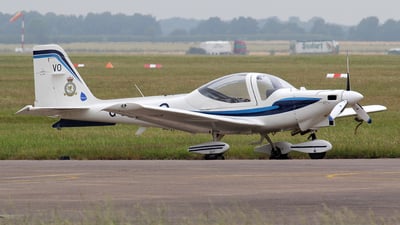
A student pilot from the University of Birmingham Air Squadron was conducting a solo training flight in a Grob G115E Tutor, registration G-BYVO. The flight was planned for aerobatics (excluding spinning) and forced landing practice. This was the pilot's first solo flight in the Tutor, having previously flown the Bulldog trainer. The aircraft had been operated earlier that day, and the engine started easily. All ground engine checks were normal, and the fuel mixture was set to best power mixture (BPM). Fuel tanks were approximately two-thirds full.
After a normal takeoff, a small mixture adjustment was made at 2,000 feet to increase fuel flow to the placarded BPM value. The aircraft leveled at Flight Level 50, with propeller at 2,500 rpm, airspeed 100 kt, and manifold pressure 19 inches. The pilot noted the manifold pressure gauge was slow to respond, but the engine performed normally. He then performed steep and maximum rate turns for 10 minutes, with normal engine indications.
The aircraft climbed for aerobatics lasting 20-25 minutes, with normal engine indications. During a stall turn to the left, at about 70 kt, the engine note changed as if slowing down. The engine recovered as the aircraft pulled out of the dive. The pilot decided to discontinue aerobatics and return to RAF Cosford.
En route, he intended to practice a forced landing. At Flight Level 40, he closed the throttle and retarded the propeller pitch lever to LOW RPM. After resetting the altimeter, he completed drills for a simulated mechanical engine failure. He informed Cosford ATC of his intent and position. During the descent, he performed an 'engine warm' check at 3,000 feet, which resulted in normal engine response. He continued gliding at 75 kt, selected takeoff flap, and performed an 'engine response' check at 2,300 feet, which was also normal.
At around 800 feet on approach to his selected field, he initiated a go-around. He moved the propeller lever to HIGH, opened the throttle, and raised the nose. The engine responded with a 'spluttering noise,' similar to an engine failing to start on the ground. He checked the throttle and propeller lever, then pressed the starter button. Realizing this was incorrect, he released it and retarded the throttle to about 2 cm open. The spluttering stopped. He pressed the starter again but saw the propeller windmilling. Recalling the drill for a windmilling propeller, he opened the throttle fully, causing the engine to splutter again. He then decided to conduct a forced landing in the selected field. He switched off the auxiliary fuel pump, transmitted a radio call, and switched off the battery master switch.
The aircraft landed with flap at takeoff position; initial contact was described as 'very heavy.' The ground was rough, and the aircraft came to rest without brakes. The pilot contacted ATC and then his squadron by phone to report the forced landing.
Meteorological conditions
At 0900 UTC, an unstable westerly flow covered the Cosford area with deep convection. Visibility was 30 km or more outside occasional showers. Cloud was generally few scattered cumulus with base around 2,500 feet, deteriorating in showers to broken towering cumulus, base 2,000-2,500 feet. Winds at surface were 260°/14 kt gusting 20-25 kt, increasing to 270°/30 kt at 4,000 feet. The pilot stated he avoided flying through showers.
Best power mixture setting procedures
The aircraft's engine injection system is set for an over-rich mixture during takeoff and landing to keep CHT below maximum. The manufacturer developed the airframe/engine combination for adequate cooling. BPM is intended for best economical operation, with engine operated 100-150°F below maximum CHT. The cockpit placard indicates 59 litres/hour at sea level with full power in flight. On the ground, because maximum rpm cannot be achieved, 4 litres/hour is subtracted from the placard figure to approximate BPM. At sea level, a setting of 55 litres/hour corresponds to the placarded 59 litres/hour.
Engine failure checklists
The RAF Pilot Operating Handbook prescribed immediate actions for engine failure (non-mechanical): set speed 75 knots, auxiliary fuel pump ON, throttle CLOSED. Subsequent actions depend on altitude: below 1,500 feet AGL, attempt restart if practical, otherwise forced landing; above 1,500 feet AGL, decide by 1,500 feet on abandoning or forced landing. Restart actions include: RPM HIGH, mixture RICH, alternate air as required, fuel selector check/change, fuel cock ON, ignition BOTH. For a windmilling propeller, open throttle smoothly; for a stationary propeller, open throttle to about 2 cm and press starter button until engine starts. If no start, close throttle and decide.
Practise forced landing procedures
In practice forced landings, the engine failure is simulated by closing the throttle and setting propeller to LOW to reproduce glide performance. The RAF study guide advises conducting an 'engine warm' check every 1,000 feet during the glide to keep CHT above 65°C: select full power, apply rudder to prevent yaw, climb attitude without trimming, hold for 3 seconds. In late stages, if CHT is above 100°C, only an 'engine response' check should be carried out: select propeller HIGH, open throttle to confirm smooth response, then retract both levers.
Investigation of the engine failure
The aircraft was dismantled and returned to RAF Cosford for investigation. It was reassembled with no adjustments to engine control or mixture settings. The air filter was found clean and dry. After refueling, an engine ground run was performed. The engine started normally; all indications were normal except for slightly low fuel pressure initially, which increased to normal. It was considered probable that initial low pressure was due to air in the fuel system after draining for recovery. The engine ran smoothly at idle (700 rpm) and after acceleration to warm-up, idled normally at 800 rpm at full throttle and BPM.