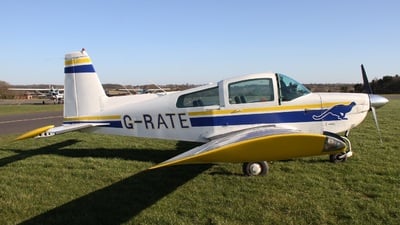
Accident
On 17 May 2009 at 1345 UTC, a Gulfstream AA-5A Cheetah (registration G-RATE) sustained damage to its right wing and propeller during a landing accident at a disused airfield at Oakley, Oxfordshire. The aircraft, manufactured in 1978, was powered by a single Lycoming O-320-E2G piston engine. The flight was private with one pilot and no passengers; the pilot reported no injuries.
Flight History
The pilot, a 30-year-old private pilot with 140 hours total experience (40 hours on type), was conducting a cross-country flight from Cranfield to Enstone. To avoid a band of rain en route, she diverted 15° left of track, intending to regain the original route by turning right 30° after 10 minutes. As she initiated this turn, the engine began to run roughly and would not produce full power. After completing the emergency checklist, full power was not restored. The pilot elected to land at the disused airfield.
Landing and Obstruction
After a normal touchdown on the into-wind runway, the pilot noticed a line of steel-cable fencing, supported by posts, crossing the runway. She turned the aircraft left onto grass and applied wheel brakes, but was unable to prevent the aircraft from striking the fence at a shallow angle, resulting in a puncture of the right wing fuel tank.
Weather Conditions
The pilot reported that forecast and actual temperatures/dewpoints were +9°C/+2°C and +10°C/+2°C respectively. Standard icing charts indicated that these conditions straddle the boundary between predicted serious icing at glide power and serious icing at cruise power. The pilot assessed carburettor icing as the most likely cause of the power reduction and rough running.