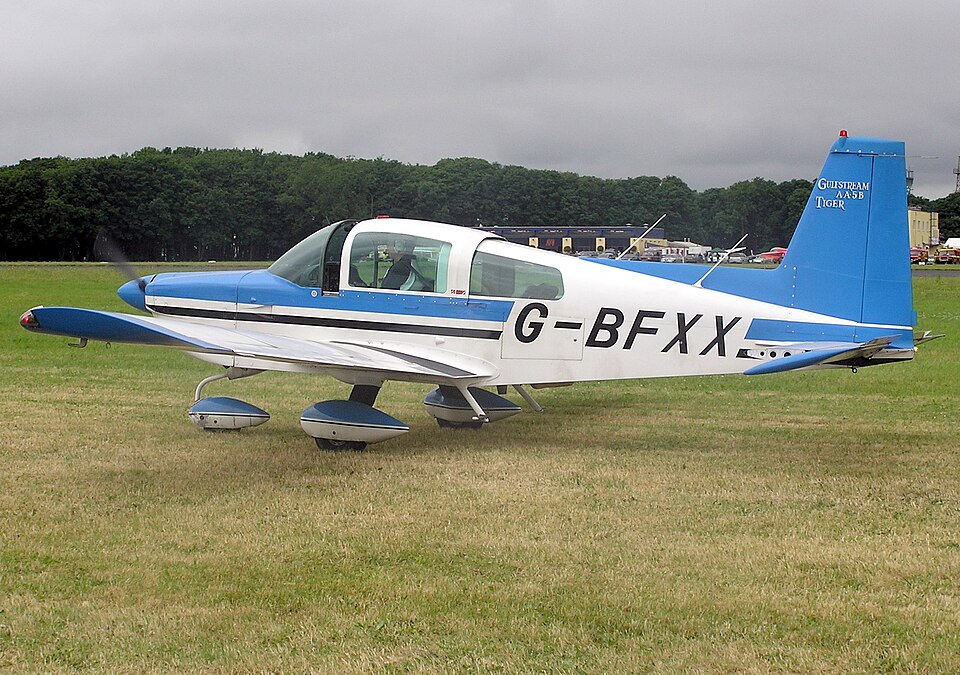
Incident
On 22 July 2000 at 1156 UTC, a Gulfstream AA-5B (registration G-BFXX) was conducting a private re-familiarisation flight near Stapleford Tawney, Essex. The pilot, who had not flown since February 2000 and held a Private Pilot's Licence with 196 hours total (5 hours on type), was accompanied by a Flying Instructor. The flight included a short navigation exercise to Haningfield Reservoir and back to Stapleford for circuits and landings.
After an uneventful cross-country segment at 2,000 to 2,500 feet, a 'touch and go' landing was performed. The aircraft positioned downwind at 1,200 feet for a landing on Runway 04. Downwind checks included carburettor heat selection, initially brief but extended on the instructor's advice. On the base leg, engine RPM was reduced to 1,500–1,600 RPM and the aircraft descended. Two stages of flap were selected for landing.
When the throttle was opened, no corresponding increase in engine RPM occurred; the engine ran smoothly but at reduced power. The pilot switched fuel tanks without improvement. The instructor assisted by verifying the booster pump was on and switching back to the original tank. With RPM still dropping, the instructor took control, selected carburettor heat to HOT, and confirmed the mixture was fully rich. The aircraft turned onto finals at about 60 kt. The instructor tried leaning the mixture and then using the fuel primer, but shortly after, the engine stopped at an altitude of 400 to 600 feet.
A forced landing was initiated in a wheat field ahead. Before emergency drills, a short MAYDAY message was transmitted to Stapleford. Airspeed was reduced to 55 kt to clear trees. With a low rate of descent and estimated airspeed of 40 kt, the aircraft was flared just above the crop. The retarding effect of the crop on the main landing gear caused the nose to pitch down sharply, resulting in a heavy landing on all three wheels, possibly with a short bounce. The aircraft came to rest with the nose landing gear bent back. Both occupants left using the normal exit. No fire occurred; the airfield Rescue and Fire Fighting Service promptly attended.
Meteorological Conditions
The London City METAR at the time indicated surface wind 040°/7 kt, visibility exceeding 10 km, broken cloud at 2,000 feet, temperature +16°C, dew point +10°C, and QNH 1023 hPa.
Fuel and Engineering Investigation
A pre-flight fuel check revealed small quantities of water in both tanks on the first sample; a second sample from each tank was clear. An engineering investigation by the repair agency found large quantities of water in the engine bulkhead fuel hoses, carburettor, mechanical fuel pump, and all four engine intake pipes. It was concluded that the engine failure occurred due to water ingestion.