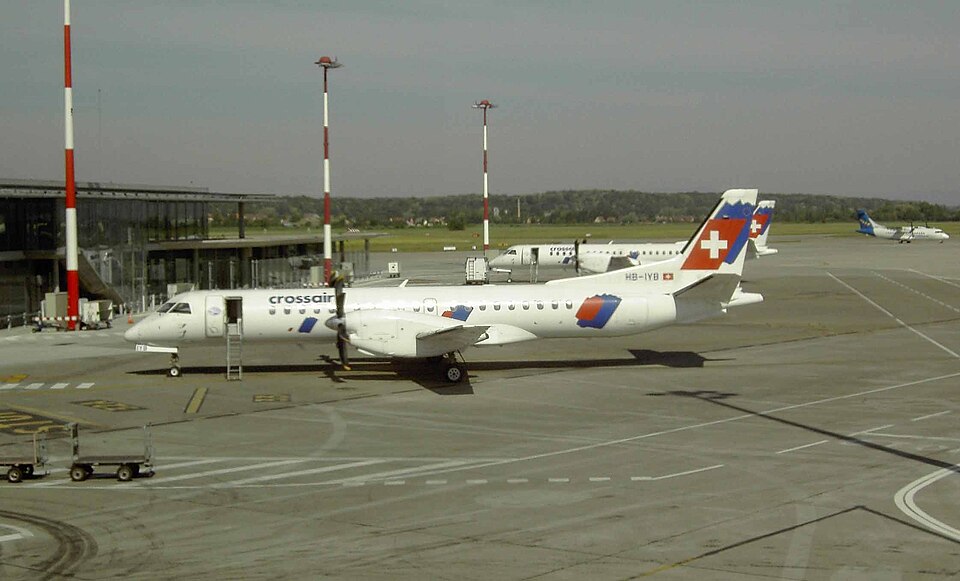
Unstabilized Approach Leads to Runway Excursion at Olbia Airport

Casualties unknown • Aeroporto di Olbia Costa Smeralda (SS), IT

A Swiss International Airlines SAAB 2000 overran the runway at Olbia Costa Smeralda after an approach characterized by excessive speed and a nose-down attitude.

What happened

On June 29, 2003, a Swiss International Airlines SAAB 2000, registration HB-IYB, was performing a scheduled flight from Lugano to Olbia when it experienced a serious runway excursion. The flight, carrying 24 passengers and 4 crew members, was cleared for a visual approach to runway 24.

During the final approach, the aircraft was significantly destabilized, maintaining a speed more than 20 knots above the target Vref. Despite the commander repeatedly noting the excessive altitude and speed to the pilot flying, no corrective action or go-around procedure was initiated. As the aircraft descended, multiple ground proximity warnings, including "sink rate" and "too low terrain," were triggered.

The aircraft touched down primarily on the nose gear. Because the main landing gear did not make sufficient contact to trigger the Weight On Wheel (WOW) signal, the anti-skid system remained unavailable. Additionally, the crew failed to activate the BETA OVRD button, leaving the thrust reversers ineffective. The resulting loss of braking efficiency and directional control caused the aircraft to slide along the runway, eventually exiting the paved surface at the end of the runway.

The investigation

The ANSV investigation focused on the flight data recorder (FDR) analysis, the physical examination of the wreckage, and the crew's performance. Investigators examined the aircraft's configuration, noting that the landing gear and flaps were extended late in the approach. The examination of the main landing gear wheels revealed severe damage, including broken components and significant deformation.

The investigation also reviewed the pilot's professional history, noting that the commander had previously demonstrated difficulties in decision-making and coordination during training. Furthermore, the investigation analyzed the crew's failure to perform required radio communications, specifically the lack of read-backs for landing clearances from Olbia Tower.

Findings

  • The primary cause was an incorrectly configured approach characterized by excessive speed and a high descent rate.
  • The nose-first touchdown prevented the activation of the anti-skid system due to the lack of a Weight On Wheel (WOW) signal.
  • The crew failed to utilize the BETA OVRD function, which would have enabled thrust reversal.
  • Poor Crew Resource Management (CRM) contributed to the event, specifically regarding degraded situational awareness and a lack of leadership/decision-making by the commander.
  • The crew did not adhere to established operational procedures for visual approaches.

Probable cause

The accident was caused by an unstabilized approach involving excessive airspeed and a steep descent angle, which prevented the anti-skid system from engaging and led to the failure of the thrust reversers to operate correctly.

Frequently asked questions

What happened in the 2003-06-29 Saab 2000, accident near Aeroporto di Olbia Costa Smeralda (SS), IT?

A Swiss International Airlines SAAB 2000 overran the runway at Olbia Costa Smeralda after an approach characterized by excessive speed and a nose-down attitude.

What aircraft was involved and where did it happen?

The accident on 2003-06-29 involved a Saab 2000,, registration HB-IYB, at Aeroporto di Olbia Costa Smeralda (SS), IT.

What was the probable cause of the accident?

The accident was caused by an unstabilized approach involving excessive airspeed and a steep descent angle, which prevented the anti-skid system from engaging and led to the failure of the thrust reversers to operate correctly.

Investigation report by the Italian National Flight Safety Agency (ANSV). Original record: https://ansv.it/wp-content/uploads/2021/08/HB-IYB.pdf. This page is a structured re-presentation; facts and quotes are in the Agenzia Nazionale per la Sicurezza del Volo (ANSV), Italy.

Loading the flight search…