History of the Flight
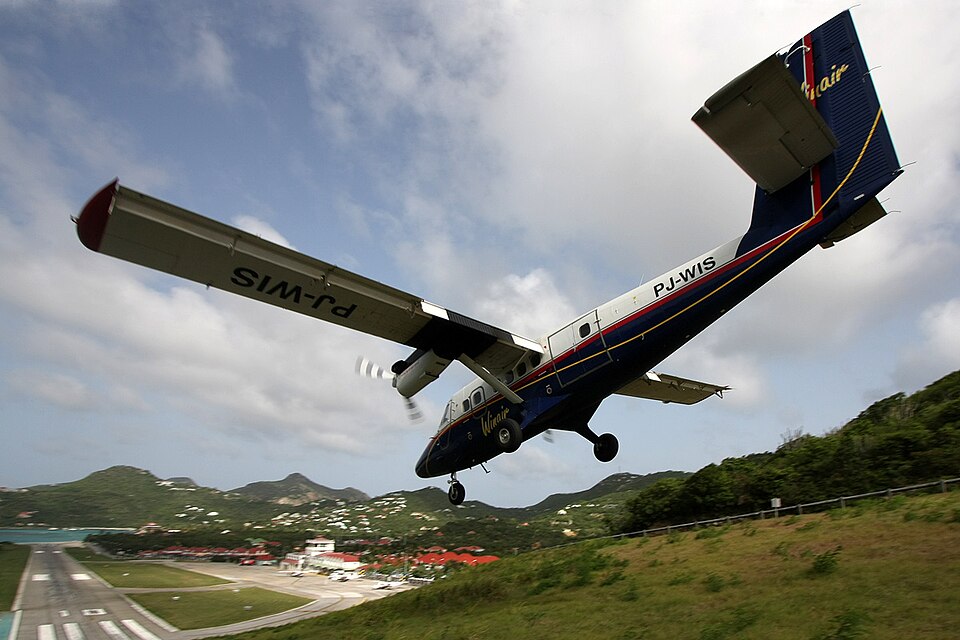
The crew operated a scheduled commercial passenger flight from Princess Juliana International Airport on Saint Martin to Saint-Barthélemy. The captain, acting as pilot flying, conducted a visual final approach to runway 10. While flying over Col de la Tourmente, the crew felt a jolt. After landing and backtracking the runway to the parking area, they reported the jolt to the controller, who informed them they had struck a plane spotter at the pass.
Additional Information
Crew Information
The captain held a Commercial Pilot Licence (Aeroplanes) and had 9,500 flight hours, 9,200 of which were on the DHC-6 Twin Otter. He possessed the required authorization to use Saint-Barthélemy airport. He stated he had lined up for final with a 090° wind of 9 kt, variable, and the aircraft was in landing configuration. He heard a noise but did not see pedestrians at the pass. The first officer also held a Commercial Pilot Licence and had approximately 800 total flight hours.
Operator Information
Winair's operations manual designated Saint-Barthélemy as a specific aerodrome. It described an approach procedure to runway 10, including required altitudes and configurations at various reference points.
Aerodrome and Surrounding Environment
Saint-Barthélemy Airport is a category D aerodrome with restricted use, reserved for aircraft with appropriate characteristics and for pilots approved by a qualified instructor. The runway is 650 m long and 18 m wide with a downward slope of 2% on runway 10. On final approach, aircraft typically overfly Col de la Tourmente with a clearance of less than 10 m. The pass lies within aerodrome constraints; a road there is used by pedestrians and vehicles. Signs warn against parking or standing in the runway centerline. Despite signs, people regularly gather at the pass to observe aircraft. On the incident date, individuals were standing on either side of the road. Since the incident, a wall and fence have been installed to prevent access to the outcrop and restricted area.
Pedestrian Information
The pedestrian, a professional photographer, stated he was on the roadside at Col de la Tourmente and had seen no prohibitive signs. He was photographing aircraft on final. The aircraft struck and destroyed his camera, throwing him to the ground. He was taken to hospital, examined, and discharged with no diagnosed injuries. It is likely the slipstream caused the fall.
Meteorological Information
At the time, wind was 100° variable between 060 and 130 at 14 kt, QNH 1016, temperature +27°C, dew point +20°C. Specific aerological phenomena can occur at Col de la Tourmente; two windsocks are positioned on either side of the pass.
Conclusions
The serious incident resulted from the aircraft flying at low height at Col de la Tourmente on visual final approach and the presence of a pedestrian in the approach centerline, despite signage indicating a hazard zone. The abnormally low path may have been due to incorrect height gauging, turbulence, or both. The investigation did not determine if the pedestrian was aware of the danger.