History of the Flight
The pilot, on his first visit to Fife Airport, flew a normal circuit pattern modified to meet local requirements. Runway 25 (hard surface, 700 m long by 18 m wide) was in use. Weather was fine with good visibility and broken cloud; surface wind from the north-west at an estimated 12 kt, variable up to 20 kt. The aircraft became high on final approach, so the pilot initiated a sideslip, a manoeuvre with which he was familiar. When the aircraft reached the flare, it had drifted to the left (downwind) side of the runway. The aircraft touched down in a crosswind, bounced, and began a porpoising motion. The pilot added power in an attempt to regain positive control and to make a second landing further along the runway, but this was unsuccessful. The aircraft adopted a nose-high attitude, veered further left, and landed again on soft ground adjacent to the runway. The nose landing gear collapsed and the aircraft came to rest on the grass in a nose-down attitude.
The pilot made the aircraft safe and assisted his passenger to vacate. Both were wearing full harnesses and were uninjured. The aerodrome fire service responded to the accident, and was joined by the civil emergency services a short time later.
Aircraft and Pilot Information
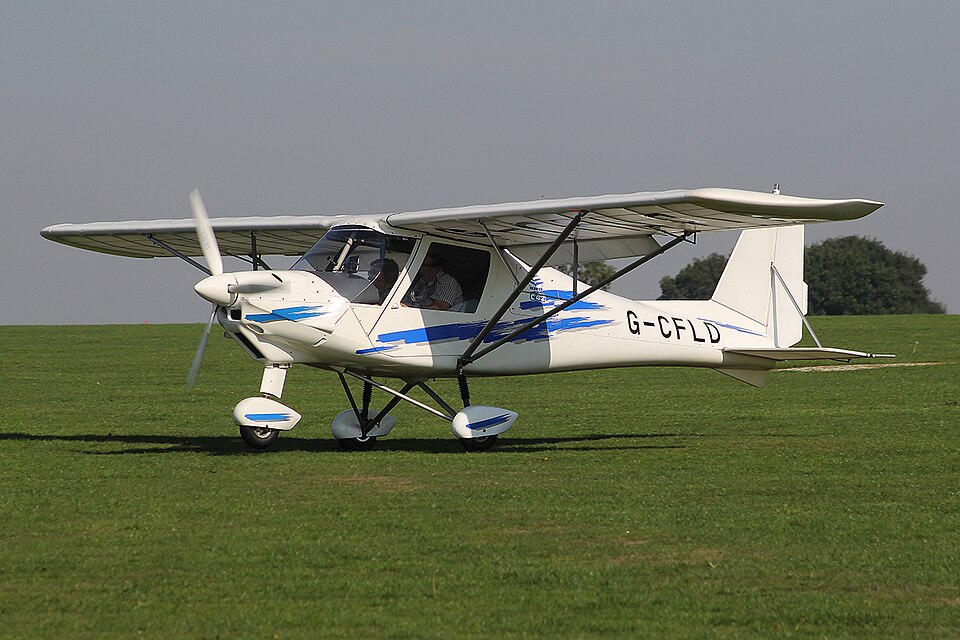
The aircraft was an Ikarus C42 FB80, registration G-CFLD, manufactured in 2008, with one Rotax 912-UL piston engine. The pilot, aged 55, held a National Private Pilot’s Licence with 198 hours of flying experience (103 on type, 21 in the last 90 days, 14 in the last 28 days). The pilot observed that the bounced landing had escalated to a worse situation through a combination of incorrect or inadequate response and inputs. He realised that it had been inadvisable to continue the approach once the aircraft had drifted to the downwind side of the runway.
Damage
The aircraft sustained damage to the nose landing gear, propeller, engine cowling, and left wheel spat.