Summary
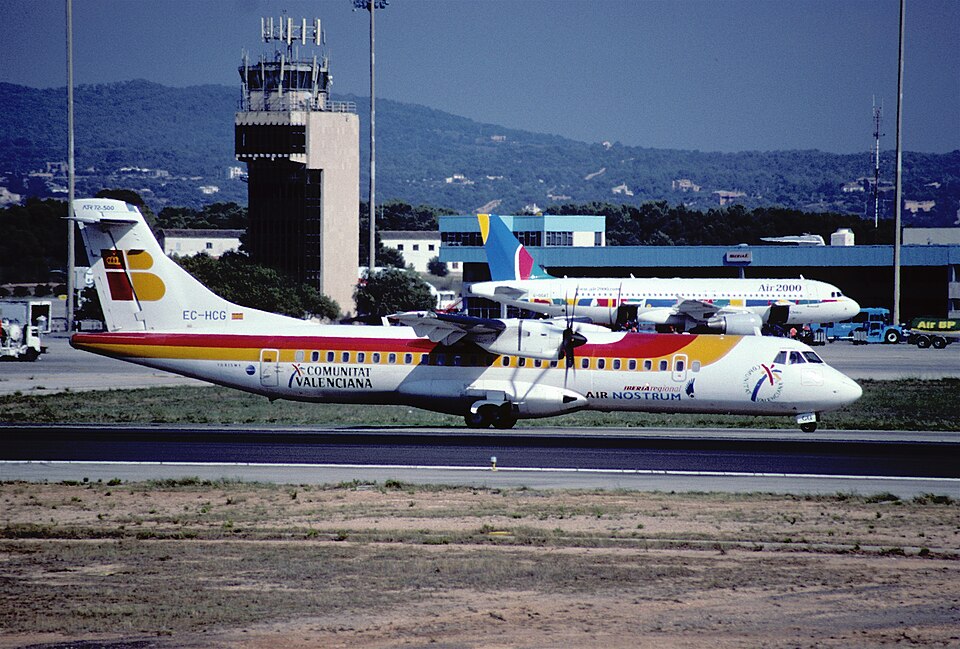
On 21 January 2012, an ATR-72-212A aircraft, registration EC-HCG, operated by Air Nostrum, struck a ground power unit (GPU) with its right propeller while preparing for departure at San Sebastian Airport (Spain). The aircraft was scheduled to operate flight IBE8317 to Madrid. No serious or fatal injuries occurred; the four crew members and 24 passengers sustained minor or no injuries.
History of the Flight
At approximately 07:30 local time, the crew began the engine start procedure. The no. 2 (right) engine was started first in "H" mode with the propeller brake engaged. A handling crew consisting of a coordinator and an operator assisted: the coordinator communicated with the flight crew via standard visual signals, while the operator managed the GPU and tow truck, including disconnecting the GPU, removing chocks, and moving the GPU.
After the right engine was started, the captain signaled the coordinator to disconnect the GPU. He then initiated the start sequence for the left engine, which does not have a propeller brake. Once the left engine stabilized, the propeller brake on the right engine was released. The captain then signaled the coordinator to remove the chocks. The operator removed the chocks and placed them in the tow truck. As he entered the truck to move the GPU, he heard screaming and noticed the aircraft moving forward, with its right propeller about to strike the GPU. He quickly moved away.
Moments later, the right propeller struck the GPU, causing all six propeller blades to break. Detached blade fragments were projected outward, striking the aircraft fuselage. The crew stopped the engines and ordered the passengers to disembark.
Damage
The right propeller lost approximately 56 cm from each blade. The right main landing gear door also impacted the GPU and was damaged. Some blade fragments struck the fuselage; most hit a reinforced area near the propellers, causing only small dents. However, a stronger impact occurred at the top of the fuselage, opening a crack that penetrated into the passenger cabin.
The GPU sustained significant damage to its rear cover. The fire extinguisher mounted on the GPU was struck and thrown to the opposite side of the aircraft. The left rear part of the GPU was also damaged by the right main landing gear door.
Personnel and Aircraft Information
The flight crew consisted of a 39-year-old captain (7,074 total flight hours, 5,254 on type) and a 41-year-old first officer (5,357 total hours, 4,791 on type). Both held ATPL licenses. The ground handling team included a flight coordinator and a ramp operator. The aircraft, an ATR-72-212A (serial number 580, built in 1999), was equipped with two Pratt & Whitney PW127F engines. Its airworthiness review certificate was valid until 21 March 2012.
Meteorological Conditions
METAR reports around 07:00 UTC indicated calm or light winds, visibility 5,000 to 10,000 meters, drizzle, scattered clouds at 800 ft, and overcast at 1,500 ft. Sunrise was at 07:34 UTC, and overcast conditions with drizzle resulted in poor visibility.
Communications
At 07:34 UTC, the crew established contact with San Sebastian control tower, requesting and receiving engine start approval, runway information (runway 14), and clearance for the flight to Madrid. This was the last exchange before the incident.