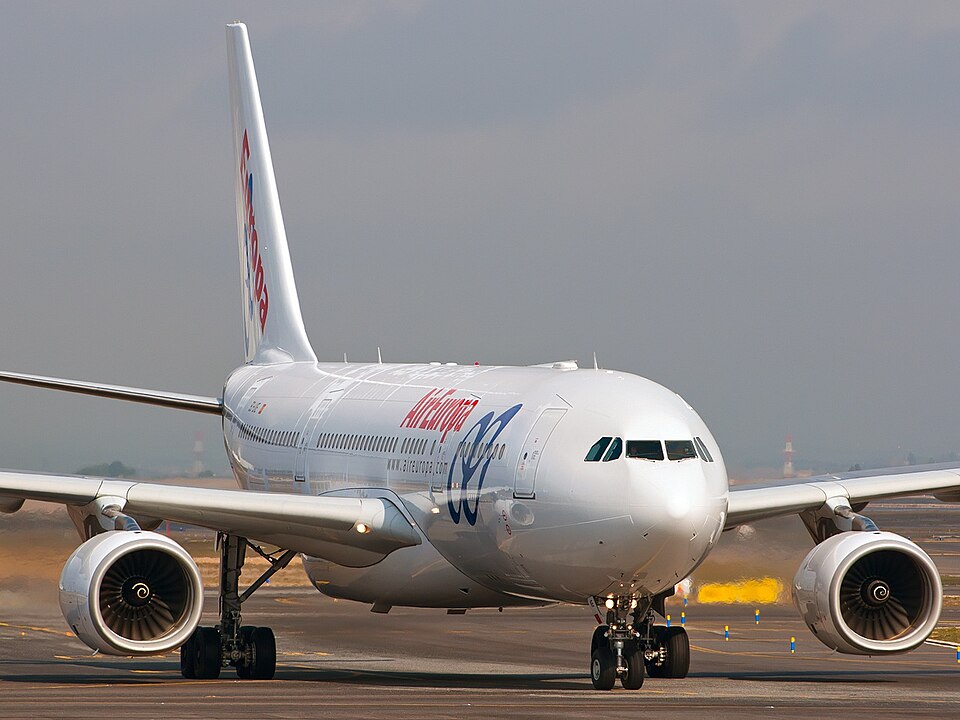
Incident Overview
On February 13, 2011, Air Europa operated flight EC-LKE, an Airbus A330-243, on a scheduled international passenger service from Madrid to Cancún. The aircraft carried 344 individuals, comprising 333 passengers and 11 crew members. Approximately 14 minutes after the start of the takeoff roll, at 16:16:03 local time, an issue occurred with the number 2 (right) engine while the aircraft was at flight level 240 near the Toledo VOR/DME.
Emergency Response and Outcome
Upon detecting the anomaly, the flight crew declared a MAYDAY emergency. They elected to return to Madrid-Barajas Airport, where the aircraft landed without further incident. All persons on board remained unharmed. The investigation was conducted by the Spanish Civil Aviation Accident Investigation Commission (CIAIAC) under report IN-003/2011.
Technical Findings
The root cause was identified as a partial detachment of fan blade number 4 (Part Number FW23741, Serial Number RGF18472) from the Rolls-Royce Trent 772B-60 engine. The blade had accumulated 4,367 cycles at the time of failure. Microscopic analysis revealed that a fatigue crack propagated from a diffusion bonding defect measuring 600 by 70 micrometers. This defect was located 150 mm from the root and 113 mm from the leading edge, situated between the suction panel and the membrane.
Contributing Factors
The bonding defect originated from an organic contaminant present during manufacturing. This contamination prevented proper material bonding and locally altered material properties without visible microstructural changes. Investigators noted that under normal operational stresses, this isolated defect would not have caused fracture within 4,367 cycles. Consequently, it is probable that the blade was subjected to loads exceeding nominal values, though the specific circumstances causing these unusual loads could not be determined.