Background
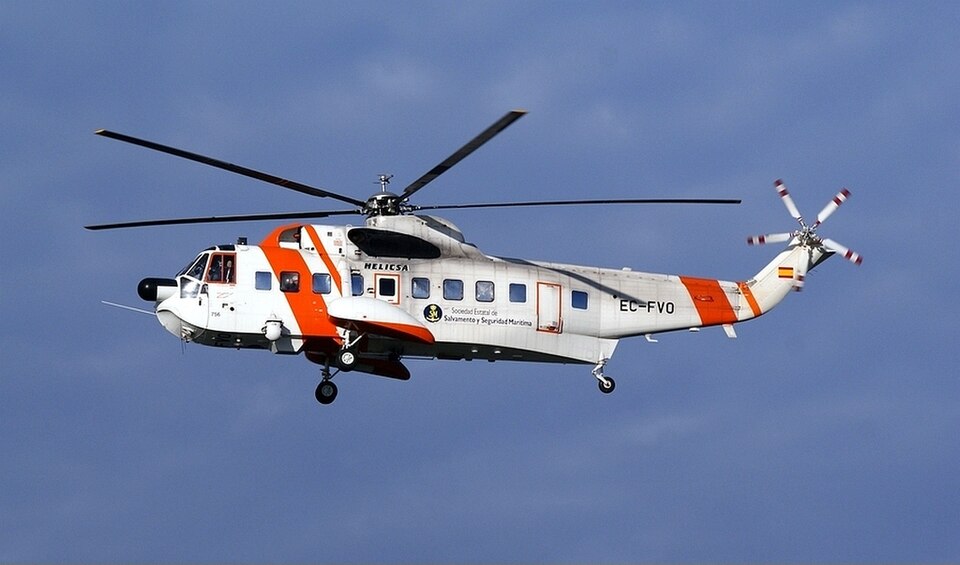
On the evening of 23 February 2008, a Sikorsky S-61N helicopter with registration EC-FVO, operated by INAER HELICÓPTEROS OFF-SHORE, was dispatched from A Coruña Airport at 20:14 to participate in a search for a body sighted floating near the southern part of Playa de San Jorge (Ferrol, A Coruña). The helicopter took off at 20:20 and reached the area 20 minutes later. Shortly after arrival, the crew was informed that a crewmember from a Civil Guard patrol boat had fallen into the water.
The Rescue Operation
At approximately 21:00, the helicopter crew located the crewmember about 150 m from the beach and prepared for a rescue. The atmospheric conditions were suitable, and the sea appeared calm, though a strong swell was present. A rescue swimmer was lowered on the helicopter’s external hoist, reached the crewmember, secured him to the cable, and gave the signal to be raised. During the ascent, with the cable tense and both men still in the water, a wave struck and broke the hoist cable at approximately 21:20.
The crewmember from the patrol boat disappeared. The rescue swimmer was spotted from the helicopter and guided toward the shore, where he was raised using an internal hoist onboard. The helicopter continued search and rescue activities and returned to A Coruña Airport at 22:55.
Aftermath
Search efforts continued through the night. The body of the crewmember who had fallen from the patrol boat was found the next day, 24 February 2008, at 10:15. During the same operation, two additional crewmembers from the same patrol boat and two from another vessel fell into the water but swam ashore.
The helicopter was equipped with a Goodrich electric rescue hoist with a 94.5 m galvanized steel cable. The cable had a nominal breaking load of 1,533 kg, and a batch test had shown a breaking strength of 1,890 kg. The hoist had 152 cycles since its last overhaul before the incident. The cable was washed and inspected the day before. The hoist cable broke due to the force of the wave.
The accident investigation did not assign a probable cause.