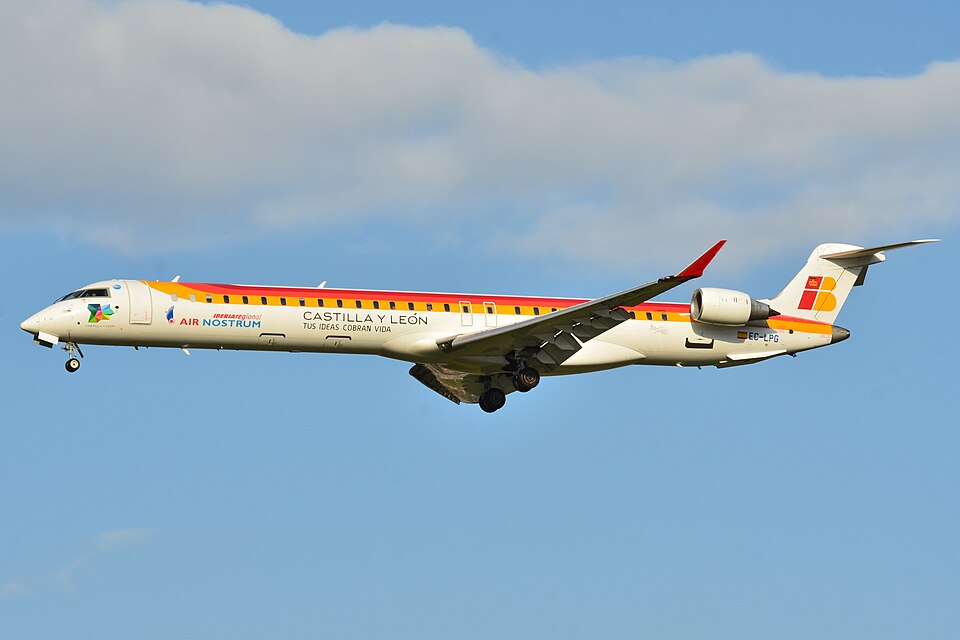
Tire burst and flat spot on Bombardier CRJ1000 following takeoff in snowy conditions

Casualties unknown • Aeropuerto de Madrid-Barajas (Madrid), ES

A Bombardier CRJ1000 experienced a tire burst and a flat spot on its main landing gear upon landing at Madrid-Barajas after operating from a contaminated runway in Pamplona.

What happened

On 1 February 2015, an Air Nostrum Bombardier CRJ1000, registration EC-LPG, was operating a scheduled domestic flight from Pamplona Airport (LEPP) to Adolfo Suárez Madrid-Barajas Airport (LEMD). The aircraft had been parked overnight in Pamplona during a period of continuous snowfall.

Prior to departure, the aircraft underwent deicing procedures. While the runway had been cleared by snow plows, the apron contained standing slush. The flight crew received braking efficiency reports for the runway in use (33) ranging from medium to poor. After takeoff, the flight proceeded normally; however, upon landing at Madrid-Barajas, the crew experienced significant vibrations from the main landing gear, which they initially identified as a tire blowout.

Upon taxiing to a parking stand, the crew confirmed that the outboard left wheel (no. 1) tire had burst and the outboard right tire (no. 4) had developed a flat spot. Additionally, white ice was observed on the main gear wheels, and debris from the tire and gear door, along with ice fragments, were found on the runway at the touchdown point. There were no injuries to the 63 passengers or 4 crew members.

The investigation

The CIAIAC investigation examined the aircraft's braking system, the maintenance history regarding snow removal from the gear, and the operational procedures used by the crew and the airport. The investigation focused on the accumulation of contaminants in the landing gear bays and the effectiveness of the runway cleaning and friction measurement procedures at Pamplona Airport.

Findings

  • Slush accumulation: It is determined that slush encountered during taxiing and the takeoff roll entered the landing gear bays. Due to the low temperatures during flight, this slush likely fell onto the brake assembly and froze.
  • Inadequate runway cleaning: The cleaning of the apron and taxiways at Pamplona Airport was insufficient, leaving slush present during the aircraft's movement.
  • Crew operational errors: The crew did not implement specific procedures to mitigate the risks of contaminated runway operations, such as heating the brakes, delaying landing gear retraction to allow contaminants to shed, or performing a more aggressive landing to dislodge frozen ice.
  • Contaminated takeoff: The presence of slush on the runway at the time of takeoff contributed to the accumulation of material in the gear assembly.

Probable cause

The primary cause of the incident was the accumulation of slush in the landing gear bays during taxi and takeoff, which subsequently froze onto the brake assembly due to low flight temperatures. Contributing factors included improper runway and apron cleaning at the departure airport and the crew's failure to follow procedures for operating in contaminated conditions.

Frequently asked questions

What happened in the 2015-02-01 Bombardier CL-600-2E25 accident near Aeropuerto de Madrid-Barajas (Madrid), ES?

A Bombardier CRJ1000 experienced a tire burst and a flat spot on its main landing gear upon landing at Madrid-Barajas after operating from a contaminated runway in Pamplona.

What aircraft was involved and where did it happen?

The accident on 2015-02-01 involved a Bombardier CL-600-2E25, registration EC-LPG, at Aeropuerto de Madrid-Barajas (Madrid), ES.

What was the probable cause of the accident?

The primary cause of the incident was the accumulation of slush in the landing gear bays during taxi and takeoff, which subsequently froze onto the brake assembly due to low flight temperatures. Contributing factors included improper runway and apron cleaning at the departure airport and the crew's failure to follow…

Investigation report by the Spanish Civil Aviation Accident and Incident Investigation Commission (CIAIAC). Original record: https://www.transportes.gob.es/recursos_mfom/2015_005_eng.pdf. This page is a structured re-presentation; facts and quotes are in the Comision de Investigacion de Accidentes e Incidentes de Aviacion Civil (CIAIAC), Spain - Ministerio de Transportes y Movilidad Sostenible.

Loading the flight search…