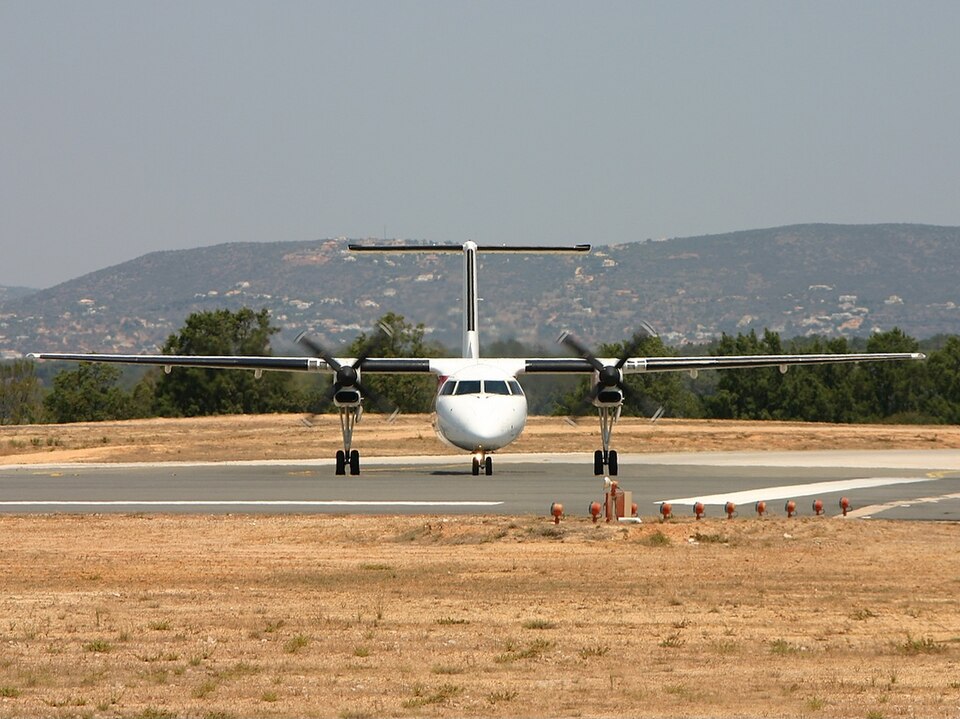
History of the Flight
The Bombardier Dash 8, registration EC-ICX, was conducting a scheduled passenger flight from Ibiza to Palma de Mallorca on February 26, 2003. The aircraft carried 51 passengers and 4 crew members. The flight was the sixth and final landing of the day for the crew, who began their duty at 14:45 UTC. Meteorological conditions were visual, with light wind and a 3 kt crosswind component on runway 24R.
Prior to landing, the crew noted a small discrepancy in hydraulic fluid quantity between the two hydraulic systems. They attempted an in-flight transfer procedure with limited success. Since the quantities remained above minimums, they prepared for a normal landing.
Upon touchdown at 19:35 UTC, all four main landing gear wheels locked, causing the aircraft to slide and skid. All four tires burst, and hydraulic pressure was lost on System No. 2. The aircraft stopped on the runway, controlled by nose wheel steering. Sparks from abrasion did not ignite a fire. Passengers deplaned via stairs and were transported by apron buses.
Injuries to Persons
All passengers and crew members were uninjured.
Damage to the Aircraft
The aircraft sustained minor damage to the main landing gear, including blowout of all four main tires and breakage of several wheels and brake components.
Other Damage
Runway 06L-24R was closed from 19:30 UTC on February 26 until 03:56 UTC the next day for aircraft retrieval and runway cleaning.
Personnel Information
The pilot-in-command, aged 57, held an ATPL(A) license with 10,664 total flight hours, 387 on type. The first officer, aged 29, held a CPL(A) license with 2,282 total flight hours, 94 on type. Both had valid medical certificates and recent proficiency checks.
Aircraft Information
The Bombardier DHC-8-315 is a twin-turboprop regional transport aircraft. The involved aircraft had an airworthiness certificate valid until April 21, 2003. It had undergone a 500-hour maintenance check on February 25, 2003, and had accumulated 4,104 flight hours and 4,172 landings at the time.
Hydraulic and Braking Systems
The aircraft has two independent hydraulic systems. System No. 1 provides power for normal braking, antiskid, flaps, and inboard spoilers. System No. 2 powers landing gear extension/retraction, nose wheel steering, outboard spoilers, and emergency/parking brake. Normal braking uses System No. 1 pressure modulated by pedal displacement, while parking/emergency braking applies System No. 2 pressure to all four wheels simultaneously via a lever.
The antiskid system controls braking to prevent wheel lock, but is inhibited below 12 knots. A shuttle valve allows either system to supply brake pressure.
Warning Systems
The MASTER CAUTION light illuminates for system abnormalities, accompanied by an aural alert. The parking brake lever, when not in forward position, activates a "PARKING BRAKE" annunciator light.
Flight Recorders
The aircraft was equipped with a digital flight data recorder (FDR) and cockpit voice recorder (CVR). The CVR recording was not preserved due to automatic erasure. FDR data showed that beginning 28 minutes before touchdown, sixteen successive MASTER CAUTION warnings occurred over 1.5 minutes at approximately 8,000 to 5,000 feet altitude. The specific cause of these warnings was not recorded.