Incident Overview
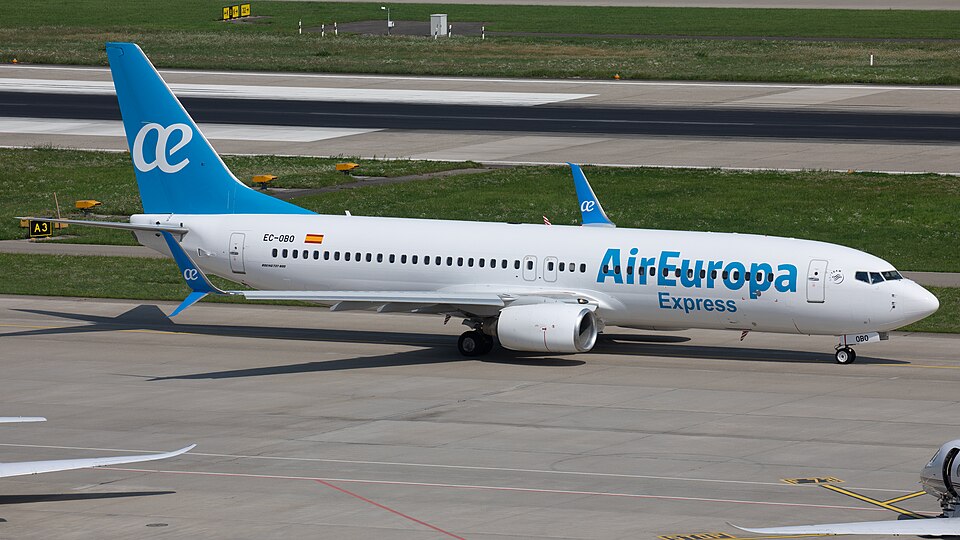
On Thursday, 28 March 2024, at 21:06 local time, a Boeing 737-800 aircraft, registration EC-OBO, operated by AirEuropa Express, was on a commercial international passenger flight from Zurich Airport (LSZH), Switzerland, to Adolfo Suárez Madrid-Barajas Airport (LEMD), Spain. While flying over the Santo Domingo housing estate in the town of Algete (Madrid), the landing gear was deployed. During this operation, a torque bar from wheel No. 2 of the main landing gear separated from the assembly and fell onto the roof of a private house, causing various material damage. The aircraft continued to its destination and landed safely.
Aircraft and Crew
The aircraft was a Boeing 737-800. The flight crew consisted of a captain holding an Airline Transport Pilot Licence (ATPL(A)) with type ratings for B737 300-900, and a first officer holding a Commercial Pilot Licence (CPL(A)) with B737 300-900 rating. The captain had flown a total of 2170 hours and 16 minutes from 4 April 2018 to 31 March 2024. No abnormalities were reported by the flight crew or by crews of subsequent flights with the same aircraft until AirEuropa Express was notified by the Civil Aviation Accident and Incident Investigation Commission (CIAIAC) on 8 April 2024.
Damage
The aircraft sustained damage to main gear wheel No. 2 (serial number Z339C20626): three torque bars together with their fixing parts and two heat shields were missing; additionally, five heat shields were damaged. Brake No. 2 (serial number 6903C20633) had two damaged rotors assemblies; two clips and their rivets were missing, one clip was broken, two clips were cracked, and one clip was deformed. The detached torque bar caused material damage to the roof of a private house in Algete. No injuries to persons on the ground or on the aircraft were reported.
Investigation and Findings
The investigation was carried out by the CIAIAC. It was determined that the torque bar that fell at Algete was only one of three that had detached from wheel No. 2. A second torque bar was found at Palma de Mallorca Airport on 30 March during an apron inspection near stand 72, in the TWR T1-T2 curve. The third torque bar was not located. The operator subsequently experienced two similar incidents: on 19 May 2024, a Boeing 737 (registration EC-OBK) equipped with wheels from another manufacturer had a loose torque bar found in the wheel well; on 8 June 2024, a loose torque bar was found on the same aircraft (EC-OBO) during a daily inspection. After these events, no further similar incidents occurred. Boeing, the aircraft manufacturer, was asked to cooperate but did not provide information for the investigation.
Probable Cause
According to the investigation, the most likely cause of the incident was the loss of tightening torque on the No. 2 wheel torque bar fastenings, which caused the torque bar to come loose. However, the investigation could not determine what caused this loss of tightening torque; it could have been due to improper or inappropriate tightening and/or improper breakaway torque of the nut to hold the tightening torque. No safety recommendations were issued.