Casualties unknown

Air Nostrum CRJ-900 Landing Incident at León Airport (EC-JZS)

Aeropuerto de León (León), ES

On April 25, 2012, a Bombardier CL-600-2D 24 (registration EC-JZS) was involved in an aviation accident near Aeropuerto de León (León), ES. This summary draws on records from the Spanish Civil Aviation Accident and Incident Investigation Commission (CIAIAC).
Sourcesthe Spanish Civil Aviation Accident and Incident Investigation Commission (CIAIAC)Primary reportUpdated 2026-09-13Data APIEditorial standards
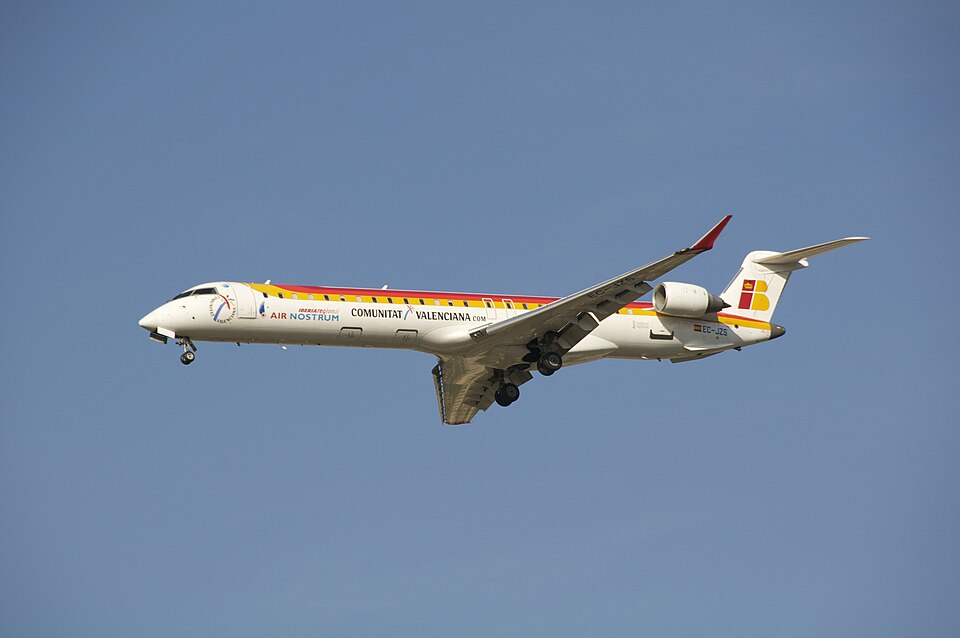
Aircraft registered EC-JZS
Aircraft registered EC-JZS. Photo: Ernesto Sierra / CC BY-SA 2.0, via Wikimedia Commons

On April 25, 2012, an Air Nostrum CRJ-900 (EC-JZS) experienced a hard landing at León Airport due to strong winds. The aircraft sustained minor damage to the right wing, with no injuries reported.

Incident Overview and Flight Details On Wednesday, April 25, 2012, at 13:00 local time, an Air Nostrum Bombardier CRJ-900, registration EC-JZS, was involved in an incident during landing at León Airport (LELN). The aircraft, a Canadaair CL-600-2D24 powered by two General Electric CF34-8C5 engines, was operating flight IB 8758, a regular domestic passenger service from Barcelona (LEBL). The flight departed Barcelona at 11:49 local time. The crew consisted of a 50-year-old captain with 11,064 total flight hours and a 29-year-old first officer with 4,068 total flight hours. The aircraft carried 63 passengers and four crew members. ## Meteorological Conditions and Approach The flight was affected by a deep low-pressure system, unofficially named “Petra,” which generated strong winds across northern Spain. At the time of the approach, the last weather report from the León control tower indicated winds from 210 degrees at 20 knots with gusts of 33 knots, overcast skies at 800 feet, and a temperature of 9 °C. The crew was authorized to perform an Instrument Landing System (ILS) approach to runway 23. They used the Flight Management System (FMS) until the final intercept course, then switched to radio navigation to capture the localizer. The aircraft emerged from the clouds at 800 feet, establishing visual contact with the field. The autopilot was used until the approach minimums, after which it was disconnected for the landing. ## Landing and Subsequent Damage During the final approach, the crew observed a sudden drop in airspeed without a windshear warning, which required an increase in engine power. They also experienced a noticeable roll to the right. The aircraft made a hard landing, with the crew feeling contact from the main landing gear followed by the nose wheel. Upon reaching the parking area at 13:05, the crew conducted a visual inspection of the main gear, tail, and right wing, finding no visible signs of breakage or damage. The aircraft then departed for Barcelona at 14:09, landing without incident at 15:17. After disembarking, the captain noticed abrasion marks on the underside of the right wing and reported them to maintenance. A detailed examination revealed four abrasion marks on the outer skin fiber, with depths up to 6 mm, but no penetrations or structural damage. One mark on the outer slat required element replacement due to thickness loss.

Investigation report by the Spanish Civil Aviation Accident and Incident Investigation Commission (CIAIAC). Original record: https://www.transportes.gob.es/recursos_mfom/2012_013_in_2.pdf. This page is a structured re-presentation; facts and quotes are in the Comision de Investigacion de Accidentes e Incidentes de Aviacion Civil (CIAIAC), Spain - Ministerio de Transportes y Movilidad Sostenible.